
Ubiquiti EF-Core Review: The 100G Enterprise Gateway That Makes UniFi a Real Edge Platform
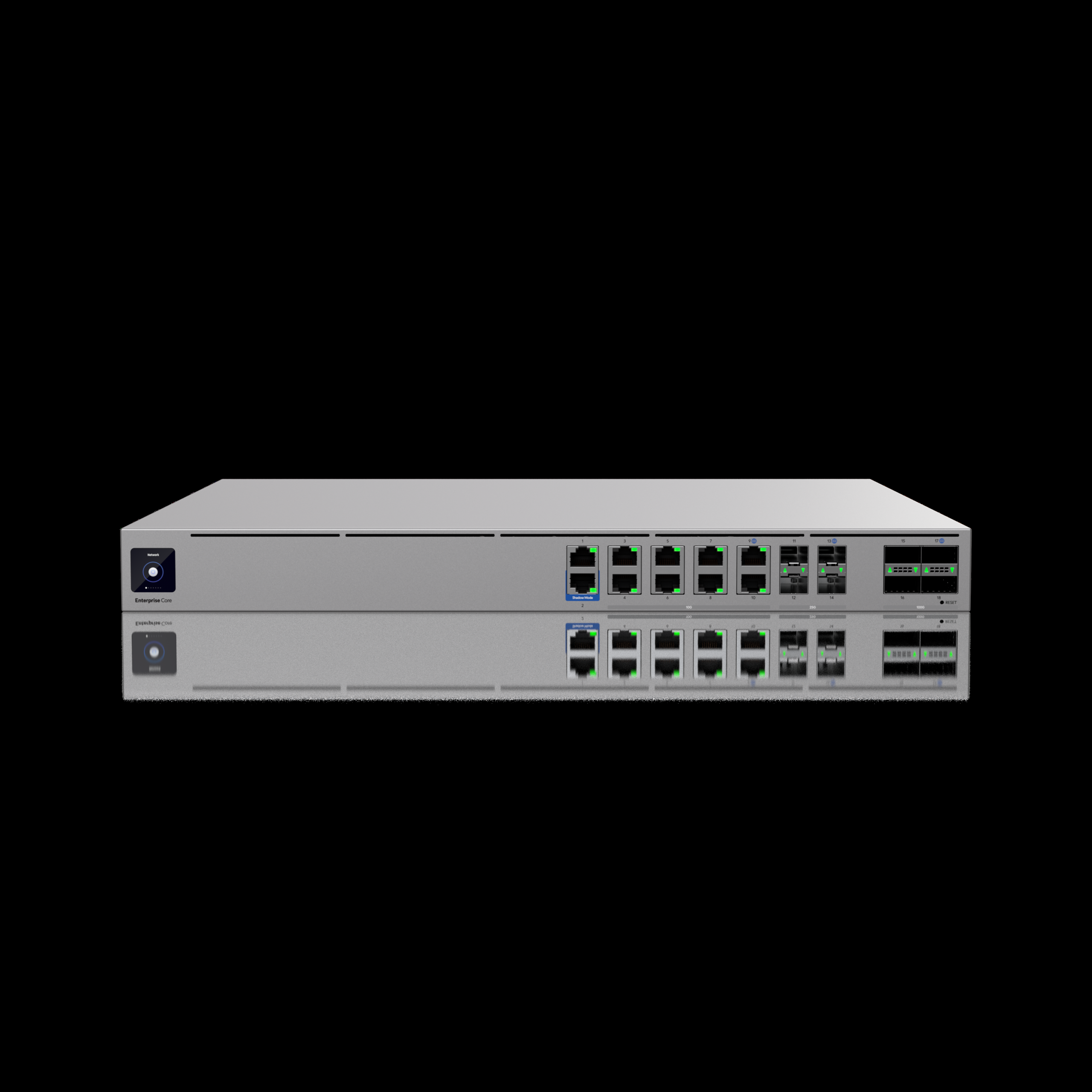
When a site crosses a few hundred UniFi devices, the Cloud Gateway Ultra you specced during the demo stops being a controller and starts being a bottleneck. That’s the moment the Ubiquiti EF-Core enters the conversation: a 1U rack-mount enterprise Cloud Gateway with real 100G uplinks, dual hot-swap power supplies, and headline numbers — 79 Gbps IDS/IPS throughput, 22,500+ simultaneous clients, and 5,000+ concurrent IPsec tunnels — that put it in a different class from the desktop UniFi gateways most integrators grew up on.
I’ve spent time with the official spec sheet and the platform’s architecture, and here’s the honest installer take: the EF-Core is Ubiquiti finally building the gateway their ecosystem outgrew, with a price that undercuts the enterprise brands it’s competing against.
What the EF-Core Actually Is
The EF-Core is Ubiquiti’s flagship “Enterprise Scale” Cloud Gateway — the brain of UniFi Network running on hardware built for edge duty at ISP and campus scale. It runs the full UniFi Network application on-board, meaning your sites, policies, clients, and VPNs are all managed from the same console you already know, no Cloud Key, no self-hosted server, no license count.
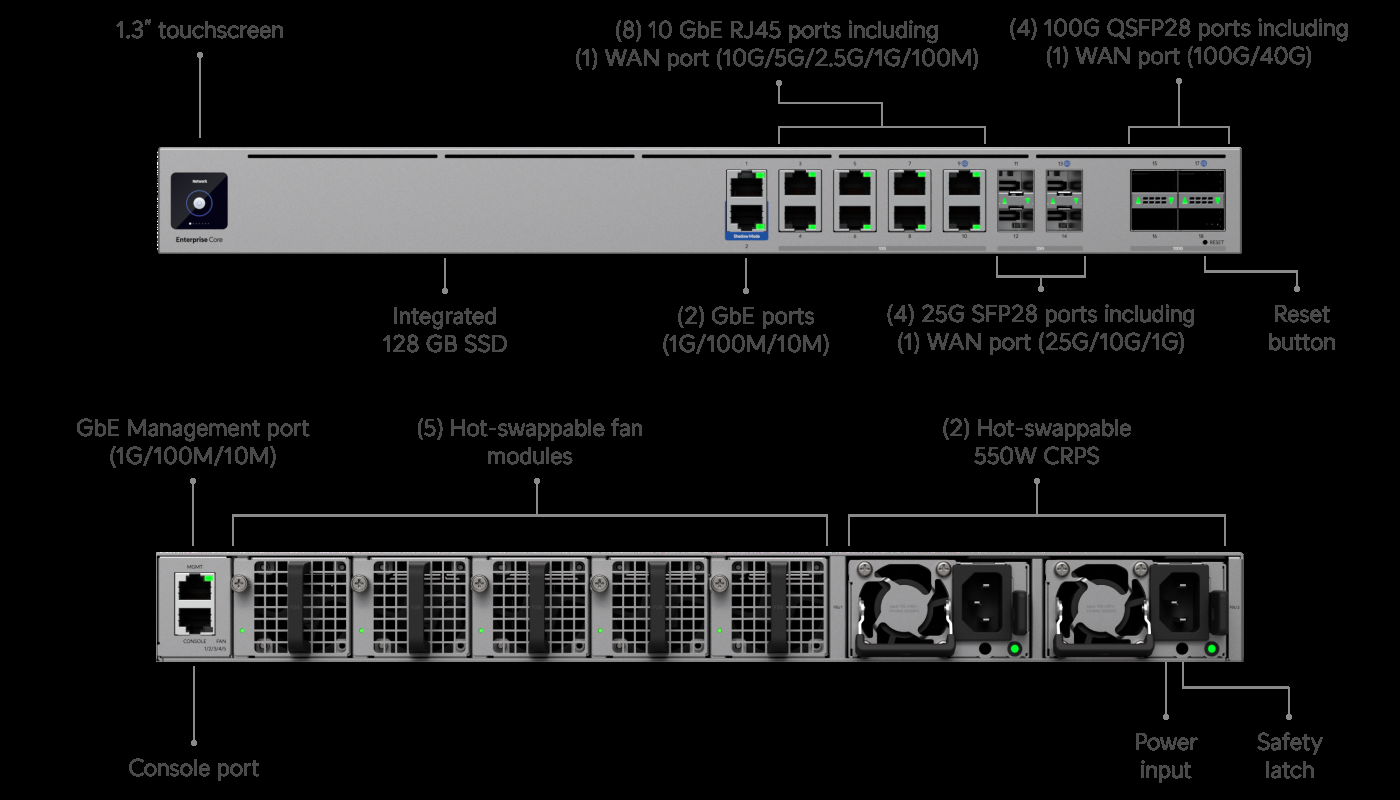
The port layout is where the enterprise story starts. You get two 1 GbE RJ45s, eight multigig 10 GbE RJ45s (10G/5G/2.5G/1G/100M), four 25G SFP28 cages, and four 100G QSFP28 cages, plus dedicated MGMT and console ports — up to eight WANs. For most integrators the QSFP28 cages will break out to 100G DR/LR single-mode or sit on a pair of DACs into a core switch. If you’re dropping one of these behind a 10G handoff today, you’re buying headroom you’ll use in three years, and the 40G/100G-capable cages mean the box won’t be the reason you re-architect later.
Verified Specifications
| Form factor | 1U rack mount, 442.4 x 43.7 x 400 mm (17.4 x 1.7 x 15.8 in), 7.85 kg (17.31 lb) |
| Processor / memory | 24-core ARM v9 at 2.5 GHz, 32 GB system memory, integrated 128 GB SSD |
| Ports | (2) 1 GbE RJ45, (8) 10 GbE RJ45 multigig, (4) 25G SFP28, (4) 100G QSFP28, MGMT, console |
| IDS/IPS throughput | 79 Gbps |
| Capacity | 22,500+ simultaneous users, 2,250+ managed UniFi devices, 10 million concurrent sessions, 120,000 new sessions/sec |
| SSL/TLS inspection sessions | 10,000 concurrent |
| Redundancy | Shadow Mode (VRRP) gateway failover, (2) hot-swappable 550W AC/DC PSUs, CRPS supplies, swappable fan |
| Security | Stateful firewall, application-aware L7 filtering, SSL inspection & URL filtering, DPI, zone-based filtering (regions/domains/apps), content filtering, IDS/IPS (95,000+ signatures with CyberSecure Enterprise), ad blocking |
| VPN / SD-WAN | License-free SD-WAN, Site Magic, IPsec (5,000+ concurrent tunnels), OpenVPN, WireGuard, L2TP, Identity Endpoint one-click VPN, Teleport zero-config VPN |
| Routing | OSPF, BGP, LACP, advanced QoS, IGMP proxy, mDNS, policy-based WAN/VPN routing, advanced NAT (SNAT/DNAT/masquerade/pooling/1:1), integrated RADIUS server with RadSec |
| Power | 100–240V AC, 7.5A max, max consumption 171W, 585 BTU/hr heat output |
| Extras | 1.3″ touchscreen display, Bluetooth management, ESD/EMP protection (air ±8kV / contact ±4kV), NDAA compliant, operating 0–40°C |
What Stands Out On a Real Job
The hot-swap power alone justifies the rack space in any shop over ~150 devices. A single-PSU gateway is a truck roll waiting to happen; with dual CRPS supplies you yank the failed brick, slide a spare hot-swap in, and close the ticket from the parking lot. Combine it with Shadow Mode — Ubiquiti’s VRRP-style failover for HA gateway pairs — and you can run an active/passive pair of EF-Cores at a campus edge with genuine N+1 power and gateway redundancy. That used to mean a different vendor’s box and a different management stack.
79 Gbps of IDS/IPS changes inspection from a checkbox to a habit. On smaller UniFi gateways, enabling full IDS/IPS is where throughput dreams go to die. With 79 Gbps rated and 95,000+ signatures (CyberSecure Enterprise) and 10,000 concurrent SSL inspection sessions, you can turn security features on and leave them on at a multi-hundred-user site. For integrators selling “security” as a line item, that’s the whole ballgame.
License-free SD-WAN matters more than it gets credit for. No per-site license SKUs, no per-feature subscription for the SD-WAN fabric — Site Magic, policy-based routing, OSPF/BGP, multi-WAN load balancing across up to eight WANs. Pair it with an EF-Core or lower-tier gateways at branches and the whole estate is one console. The optional CyberSecure Enterprise subscription ($499/unit/year billed annually, Proofpoint-powered) is there if the customer wants managed threat intelligence layered on top — sell it as a monthly managed service line and keep the margin. And note the on-board box ships with 90 days of professional phone support when purchased through the UI Store in the US, Canada, Europe, and the UK — worth more on an enterprise edge than most people realize.
Where It Fits — and Where It Doesn’t
Pros:
- Genuine throughput headroom: 79 Gbps IDS/IPS at the edge, 100G uplinks standard
- True enterprise resilience: dual hot-swap PSUs, VRRP HA pairs, swappable fans
- Full routing stack (OSPF/BGP) — you can trust it as a real edge router, not just a controller with a WAN port
- License-free SD-WAN and one unified console for network + security policy
- NDAA compliant — clears procurement bars the Chinese enterprise brands trip on
- Roughly a third to a fifth of what comparable 100G-class enterprise firewalls quote list
Cons:
- It’s UniFi: cloud-first management. If your customer mandates fully offline control planes, verify the self-hosted path before you commit
- 15.8-inch (400 mm) depth — fine in a decent-depth rack, tight in a shallow wall-mount enclosure; check your rails and cable bend radius
- No integrated wireless controller separate from Network — it’s all one app, which is a feature or a single point of policy failure depending on your philosophy
- The 10,000 SSL inspection session cap is well below the 10M general session count — heavy inspection designs need throughput math before the sales visit, not after
- Runs hot at full tilt (585 BTU/hr) — plan rack airflow accordingly, especially in a 1U next to a NAS running disks

Pricing (Official UE Store, US)
- EF-Core single unit: $3,499 ($3,855 with surcharge incl.)
- HA pairs, UI Care 5-year coverage ($699/unit), and CyberSecure Enterprise ($499/unit/yr) offered as store add-ons
- 100G DAC from $35; 100G PSM4 single-mode module $179; 25G DAC from $23
Bottom Line
The EF-Core is the UniFi gateway for the moment your project stops being one building and one rack: multi-hundred-user campuses, multi-site SD-WAN shops, and integrators who want hot-swap power, 100G uplinks, and always-on IDS/IPS without an enterprise firewall’s license math or a training week on somebody else’s OS. If your site fits in a UCG-Fiber’s capacity, save the money. When it doesn’t, this is the box that lets you stay in the ecosystem all the way to the data center edge. If you want help sizing an EF-Core HA pair or the optics to feed it, get in touch.
Product specifications and pricing sourced from the official Ubiquiti UE Store product page (store.ui.com), October 2026. All product images are official Ubiquiti renderings.