
Grandstream GWN7822P Review: The Layer 3 Multi-Gig PoE Switch That Undercuts Enterprise Pricing
The GWN7820 series is Grandstream’s answer to a problem every integrator runs into on mid-size jobs: you need real Layer 3 switching and PoE++, but the enterprise brands quote like it costs extra just to say the word “stacking.” The GWN7822P is the big sibling in that series — 24 Ethernet ports (16x 1G, 8x 2.5G), 4x SFP+ 10G uplinks, and a 360W PoE budget — and on paper it punches well above its price class. Here’s the full verified spec rundown from Grandstream’s official datasheet, and where this switch actually fits in a production install.
What the GWN7822P Actually Is
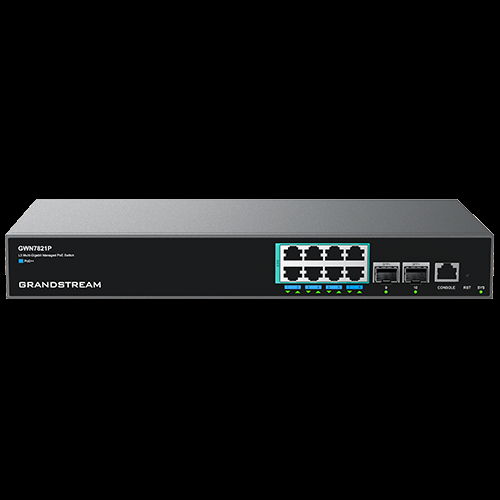
The GWN7820 series sits between Grandstream’s GWN7800Pro/L2+ line and the GWN7830 aggregation series. The 7820 models are Layer 3 multi-gigabit managed PoE switches — meaning dynamic routing, stacking, and full L2/L3 feature sets in a compact 1U-form-factor box (44mm tall), desktop or rack-mount with included kits.
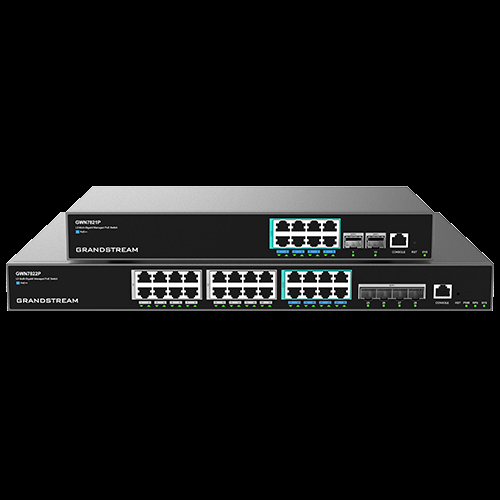
The GWN7821P is the compact model: 8x 2.5G copper ports, 2x SFP+, 240W PoE budget. The GWN7822P is the one most installs will want: 16x 1G plus 8x 2.5G copper, 4x SFP+, and a 420W PSU with 360W allocated to PoE, plus support for an external redundant power supply. Both do full PoE++ (802.3af/at/bt) with smart dynamic allocation up to 60W per port — note the port split on the 7822P: ports 1-16 max out at 30W, ports 17-24 get the full 60W PoE++ budget.
Full Verified Specifications (GWN7821P vs GWN7822P)
| Spec | GWN7821P | GWN7822P |
|---|---|---|
| Copper ports | 8x 2.5G | 16x 1G + 8x 2.5G |
| SFP+ 10G uplinks | 2 | 4 |
| PoE standards | 802.3af/at/bt (PoE/PoE+/PoE++), smart dynamic | |
| Max PoE per port | 60W | 30W ports 1-16, 60W ports 17-24 |
| Total PoE budget | 240W | 360W (420W PSU) |
| Redundant power support | — | RPS 54V/300W (optional) |
| Non-blocking throughput | 40Gbps | 76Gbps |
| Switching capability | 80Gbps | 152Gbps |
| Forwarding rate | 59.52Mpps | 113.088Mpps |
| MAC table / VLANs | 16K MAC, 4K VLANs, jumbo frames 12288 | |
| Switching latency | <4µs | |
| Stacking | Yes, up to 4 units | |
| Memory | 256MB RAM, 8MB NOR + 128MB NAND flash | |
| Surge protection | ±6KV CM/DM power, ±4KV CM network; ±12KV ESD contact | |
| Management | Embedded controller, CLI, GDMS cloud, GWN Manager (on-prem, free), GWN routers | |
| DIMENSIONS/WEIGHT | 330×175×44mm, 1.9kg | 440×300×44mm, 4.1kg (rack kits included) |
On the L3 side both models run static and dynamic routing (RIP/RIPng, OSPF/OSPFv3, BGP), full spanning tree family (STP/RSTP/MSTP/PVST+/RPVST+, 32 instances), IGMPv2/v3 and MLD snooping with 256 groups, 802.1X and MAC authentication with RADIUS/TACACS+, DAI, IP source guard, DHCP snooping with options 43/60/82/160, storm control, loop/BPDU/root protection, dual boot with dual system file redundancy, 2K ACLs with time-scheduled rules, and even 1588 PTP transparent clock for high-precision time sync — a genuinely useful feature on surveillance and broadcast-adjacent jobs where GPS timing isn’t practical.
Installer Notes: Where This Fits
The sweet spot: 20–100 endpoint shops that have outgrown L2-only access switching but won’t pay enterprise prices for dynamic routing. If you’re running UniFi or Omada access and a controller license gets expensive per site, the GWN line’s free GDMS cloud and free unlimited on-prem GWN Manager are the quiet selling point — no per-device licensing, ever.
PoE++ planning: the 60W per-port allocation on the 7821P and ports 17-24 of the 7822P matters now that Wi-Fi 7 APs and PTZ domes routinely pull 30-60W. Put your heavy consumers on the 2.5G/PoE++ ports and the 1G ports on the 7822P will happily carry phones and printers on the 30W ceiling.
Stacking caveats: stacking supports up to 4 units, and SFP+ DAC runs must be ≤5m per the datasheet. A few features — GVRP, ERPS, policy routing, VRRP, UDLD, TR-069 — are still marked “pending” in the official spec sheet, so confirm firmware support before committing to a design that assumes them.
Good fits: small IDF closets that need L3 at the edge, surveillance aggregation feeding an NVR, hospitality MDU closets, and multi-site shops standardizing on GWN’s free management. Bad fits: full L3 aggregation cores (buy the GWN7830 series), or anywhere you need per-port full PoE++ across all 24 copper ports.
The Management Plane Is the Real Product
Anyone can put 10G SFP+ cages on a board. What wins deals is how you run two hundred switches across twelve sites on a Friday afternoon, and this is where Grandstream quietly wins on cost of ownership. Every GWN switch ships with an embedded web controller, a full CLI for people who actually read RFCs, GDMS Networking cloud management at no charge, and GWN Manager on-prem licensed for an unlimited number of devices. There is no per-seat, per-device, or per-site license anywhere in the feature list, which changes the math on multi-location jobs the moment a competitor quotes you a controller license.
The day-to-day features I lean on in this class of switch all made the datasheet: LLDP and LLDP-MED for phone and AP discovery, SNMPv3 for the monitoring stack, RMON for historical interface data, port mirroring with SPAN and RSPAN so a packet capture box can watch the voice VLAN without a TAP, and per-device power and fan alarms with fault detection — which, on a 420W PSU feeding 360W of PoE, I treat as mandatory monitoring rather than a nice-to-have. Dual boot images and dual system files mean a bad firmware push on a remote site becomes a reboot instead of a truck roll, and provisioning through DHCP options 43/60/82/160 keeps phone and AP VLAN assignment clean from day one.
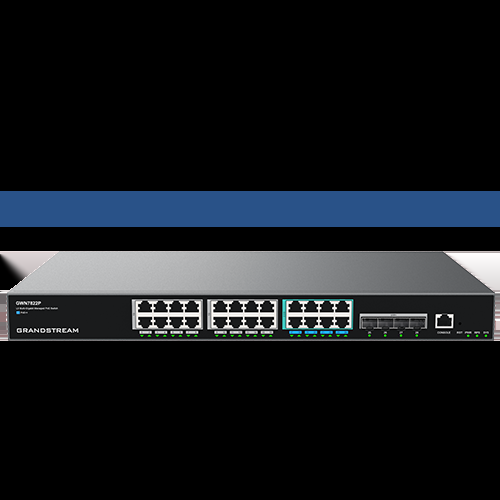
On physical install, the 7822P is a real rack brick: 440mm deep, 4.1kg, dual fans, with rack kits, ground cable, and the anti-trip power cord keeper included in the box. That depth matters in a wall-mount can or a shallow 12U closet — measure before you commit to the deep side of the rack. The ±6KV/±4KV surge protection on power and network ports is spec-sheet insurance you will thank the vendor for on any rural or pole-mounted run, and the Kensington slot has saved more than one desktop-mounted switch in a lobby.
For the smaller closet where you do not need the port count, the GWN7821P is the same feature set in a 330mm desktop box with 8x 2.5G ports and a 240W budget — one caveat for redundancy-minded designs: the datasheet shows no external RPS option on the 7821P, so if you need dual power feeds, the 7822P is the only version in this series that can take one. And per the datasheet module table, mind the SFP+ module limits when mixing 10G optics with RJ45 modules on either model.
Pros and Cons
Pros:
- Genuine Layer 3 (OSPF, BGP) at a price where competitors sell you L2+
- PoE++ support with per-port dynamic allocation and a 360W budget on the 7822P
- Stacking up to 4 units without extra licenses
- Free management three ways: embedded controller, GDMS cloud, unlimited-licence GWN Manager on-prem
- Hardened feature set: dual boot, dual system files, ±6KV surge, Kensington slot
- 1588 PTP TC, MLD snooping for IPv6 deployments
- Rack kits included in the box on the 7822P
Cons:
- 7822P ports 1-16 capped at 30W — full PoE++ only on ports 17-24
- 7821P has no redundant power option; only the 7822P supports RPS
- Several features (GVRP, ERPS, policy routing, VRRP, UDLD, TR-069) listed pending on the datasheet
- 2.5G ports are the majority of copper on the 7821P only — the 7822P is mostly 1G, so cable and NIC planning matters
Bottom Line
If your bill of materials has an access layer that needs PoE++ headroom and dynamic routing without an enterprise license sheet, the GWN7822P is one of the best price-per-port L3 PoE switches you can spec today, and the free unlimited GWN Manager is the kicker on multi-site jobs. Respect the pending-feature list on the datasheet, put your heavy PoE devices on the right ports, and this switch will quietly disappear into the network the way good infrastructure should. Building a multi-site design and want a second opinion on the access layer? Get in touch.
Specifications sourced from Grandstream’s official GWN7820 series product page and datasheet (grandstream.com). Product imagery courtesy of Grandstream Networks.