
Ubiquiti Cloud Gateway Max (UCG-Max) Review: The 16-Watt Box That Outgrew the Rack
The Ubiquiti Cloud Gateway Max, or UCG-Max, sits in an awkward spot in the UniFi lineup on paper — it is smaller and cheaper than a Dream Machine Pro — but in practice it has quietly become the box I reach for on small-office and heavy-remote-worker jobs. It runs the entire UniFi application suite, including Protect, on hardware that draws 16 watts and is powered over USB-C. That is not a spec sheet typo.
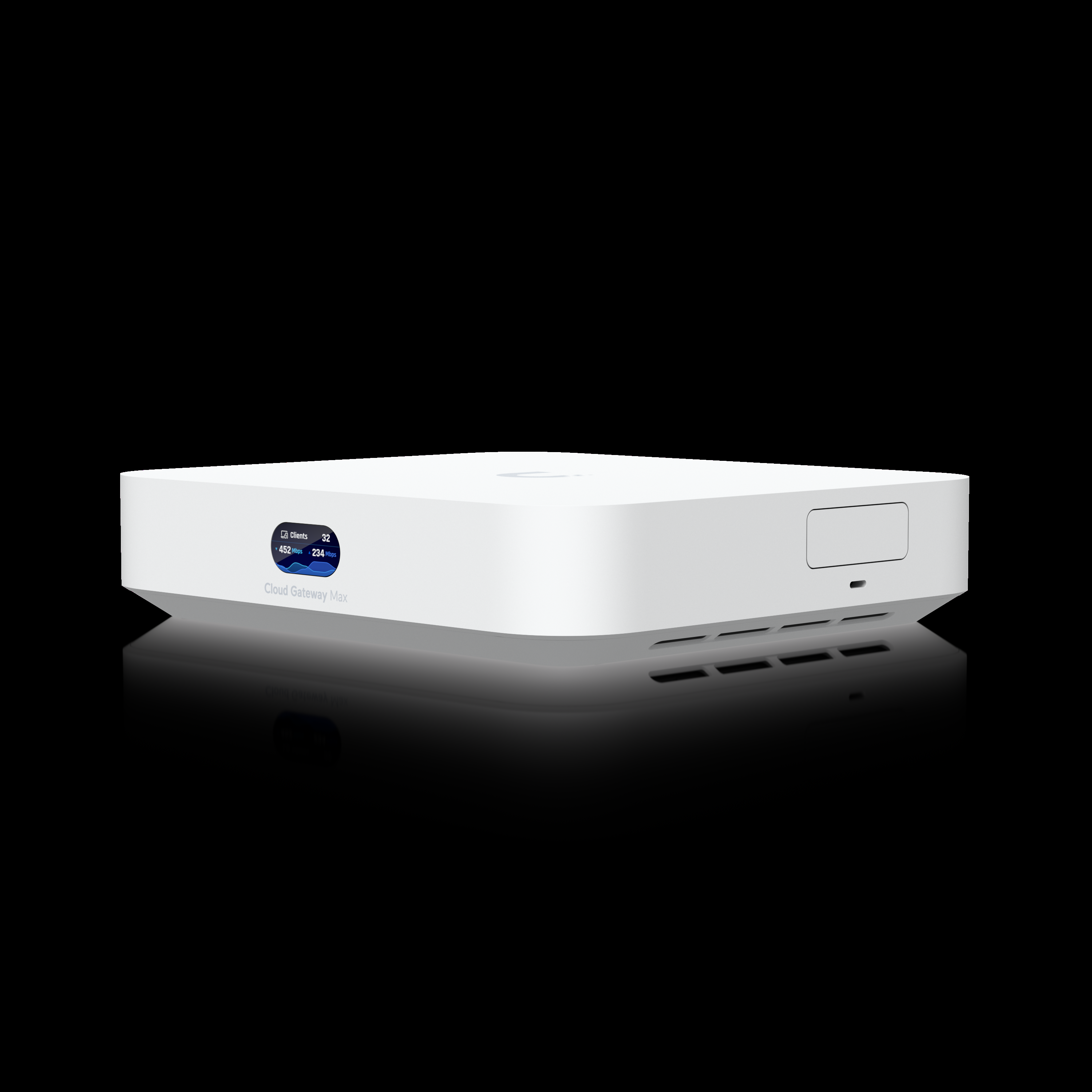
Verified specifications
All of the following comes straight from Ubiquiti’s official techspecs page for the UCG-Max:
- Processor: Quad-core ARM Cortex-A53 at 1.5 GHz
- Memory: 3 GB
- Storage: Selectable NVMe SSD up to 2 TB (NVR storage), or no-storage SKU
- Ports: (1) 2.5 GbE RJ45 WAN + (4) 2.5 GbE RJ45 LAN (2.5G/1G/100M/10M auto)
- IDS/IPS throughput: 2.3 Gbps
- Managed device limits: 30+ UniFi devices; cameras: 15 HD / 8 2K / 5 4K; 50 Access Hubs; 300+ simultaneous clients
- Applications: Network, Protect, Access, Talk, Connect — all supported on-box
- Firewall: Full stateful, application-aware Layer 7 with DPI, zone-based filtering, content filtering, ad blocking, 55,000+ IDS/IPS signatures (with CyberSecure)
- VPN: License-free SD-WAN, Site Magic, IPsec, OpenVPN (server + client), WireGuard, L2TP, Teleport one-click VPN, Identity VPN
- Routing: Multi-WAN load balancing, OSPF, BGP, policy-based WAN/VPN routing, IGMP proxy, mDNS relay
- Services: Integrated RADIUS server with RadSec (RADIUS over TLS), customizable DHCP, advanced NAT (SNAT/DNAT/masquerade/NAT pooling/1-to-1)
- Power: USB-C (5V DC/5A), adapter included, max 16.1 W (55 BTU/hr)
- Size/weight: 141.8 × 127.6 × 30 mm (5.6 × 5 × 1.2 in), 460 g bare / 519 g with SSD; polycarbonate enclosure; 0.96″ status display
- Management: Ethernet + Bluetooth; NDAA compliant; CE/FCC/IC certified
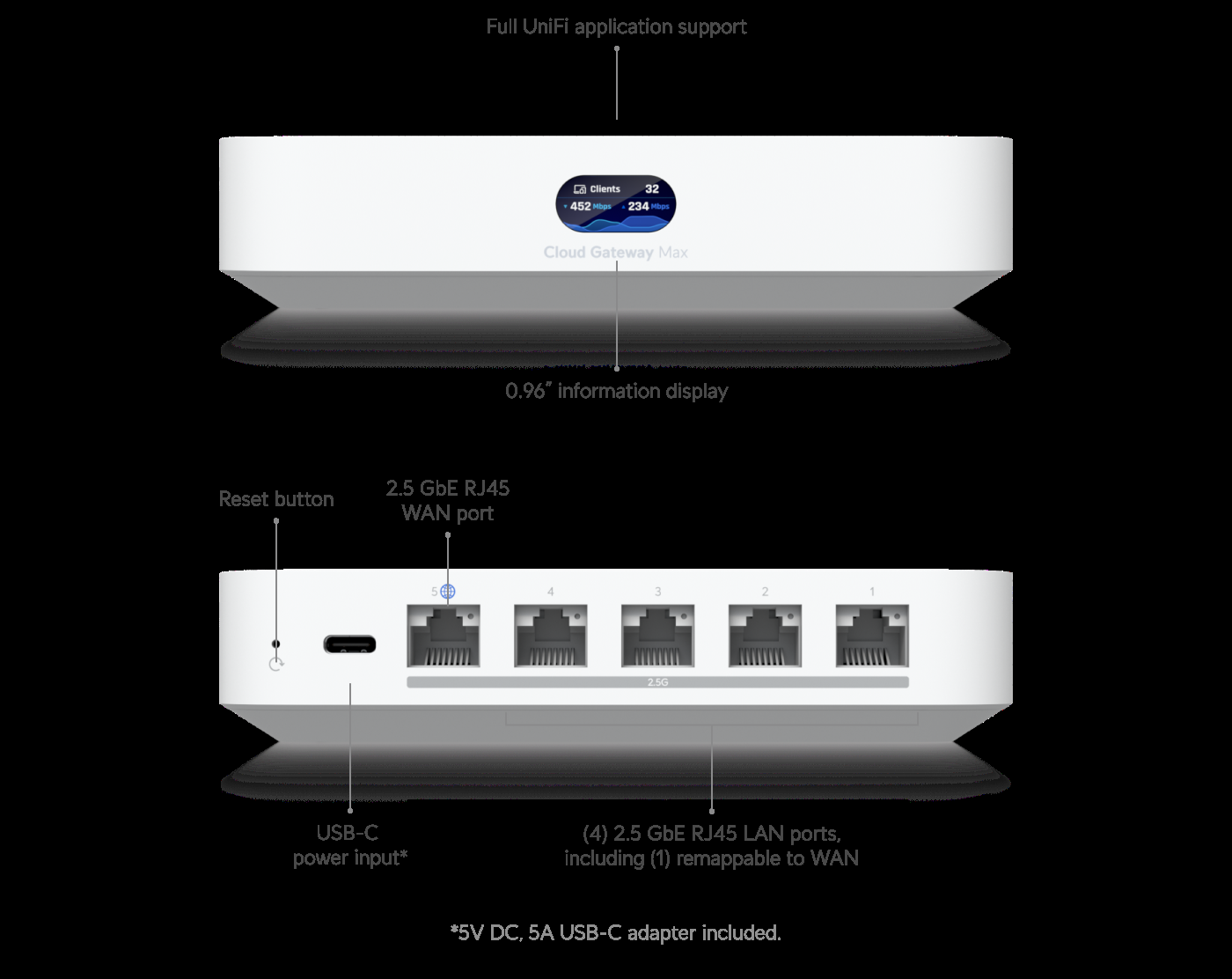
What actually matters on a job
The headline numbers undersell two things. First, the security stack: this is the same UniFi OS firewall as the big Dream Machines — application-aware Layer 7 rules, zone-based filtering, and a 55,000-signature IPS engine pushing 2.3 Gbps. For a site with a 1 Gbps symmetric fiber handoff, you can leave IPS/IDS on full time and still saturate the pipe. For years the correct answer for “I want real IPS at gigabit speeds” was a box three times this size; that’s no longer true.
Second, the four-port 2.5GbE switch is not a toy switch. On a desk-drop job I routinely wire the NAS, a workstation, and the office switch into it directly and get a real multigig core with no separate switch. The single 2.5G WAN is the ceiling though — if the circuit is 2.5G or faster you want a Dream Machine-class box with 10G WAN, not this.
Camera limits are the gating spec for Protect builds: 15 HD, 8 2K, or 5 4K. A six-camera 4K shop fits; a twenty-camera warehouse does not. The optional NVMe SSD makes Protect recording silent and vibration-proof, which matters in a retail back room — but Ubiquiti sells the no-storage SKU too, so spec the SSD at order time if the site is a Protect site, because the price gap now is smaller than the drive hunt later.
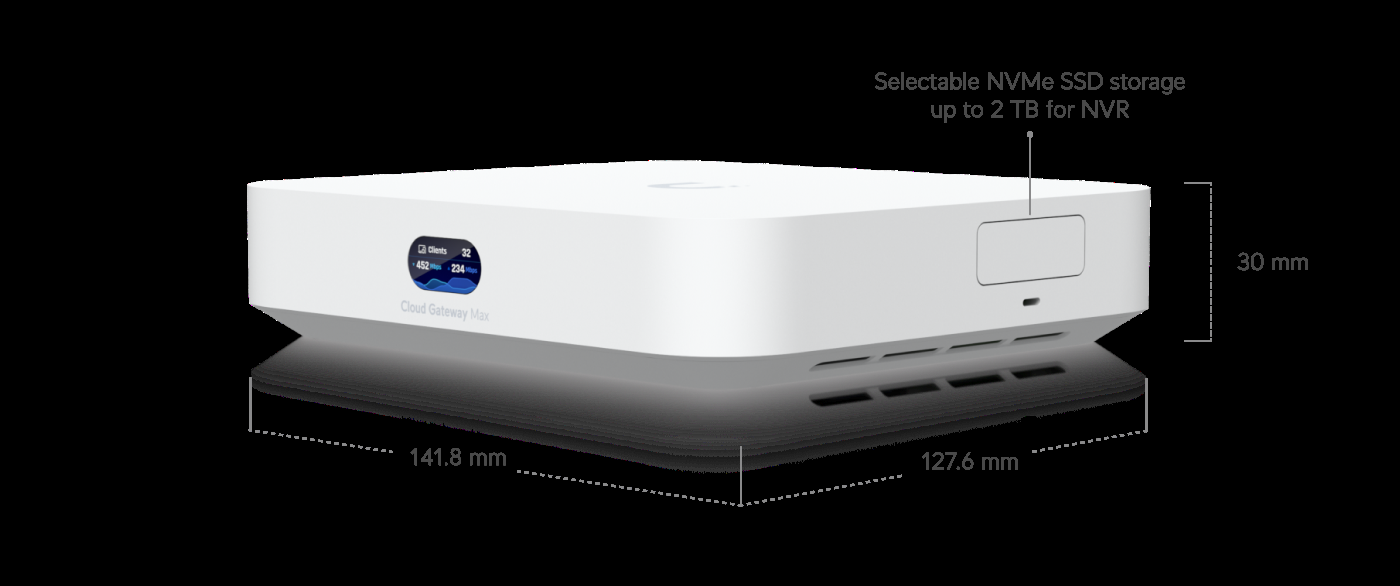
Where it fits — real use cases
Small office, 10–20 users, gigabit fiber. Sweet spot. Full UniFi suite on one 16 W box, single-cable-on-the-desk simplicity, and the whole thing runs off a UPS the size of a brick.
Power-sensitive or space-limited racks. It is not rackmount, but for a closet shelf, AV rack bay with shelf space, or a shop counter it beats a 1U Pro on space and heat any day.
Site-to-site hub for remote workers. License-free SD-WAN, Site Magic, Teleport, and both WireGuard and OpenVPN server on the same box, with integrated RADIUS + RadSec for network login. A lot of MSPs pay monthly for VRAID-grade features that live on this thing at no additional license cost.
Where it doesn’t fit: more than 30 UniFi devices, more than 5 4K cameras, SFP+ WAN, or anyone who needs hot-swap storage. The polycarbonate case and USB-C power also mean this is a desktop-class device in a rack-grade world — fine for an office, wrong for an unconditioned comms closet in Arizona.
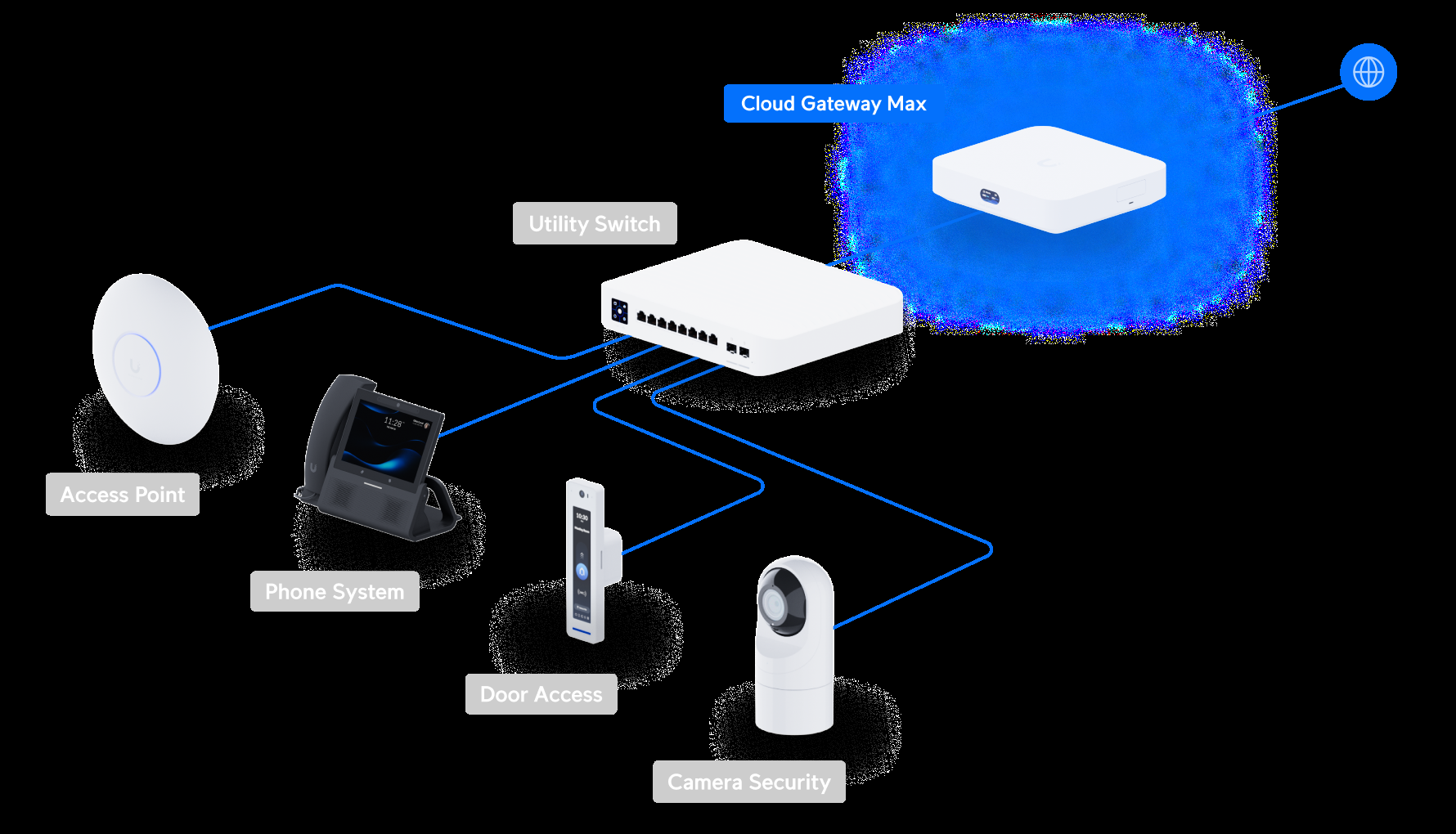
Installer notes from the field
A few things the spec sheet doesn’t tell you. The USB-C power adapter Ubiquiti ships is a genuine 5V/5A brick — if you swap it for a phone charger to save a outlet, you will get brownouts under Protect write load and mysterious reboots at the worst time. Keep the included supply, and put it on the UPS. Second, the single WAN port is on the 2.5G NIC, not a separate chip path — if your ONT hands off at 1G you lose nothing, but a 2.5G handoff plus enabled IPS will run right at the 2.3 Gbps ceiling, so leave yourself headroom on the circuit or move up. Third, the NVMe bay takes a standard M.2 2280 — install the drive before the first boot so UniFi OS formats it into the Protect storage pool cleanly rather than asking you to remount mid-quarter.
Airflow is passive. The polycarbonate case is rated to 40° C, but a closed closet with a PoE switch underneath cooking at 45 will throttle it. I mount these on a shelf ledge with an inch of clearance front and back, Velcro base down, and they never run hot enough to hear.
How it stacks against the rack lineup
Versus the Dream Machine Pro: the UCG-Max drops hot-swap storage, rack ears, and SFP+ WAN, but keeps the same UniFi OS feature set, runs circles around it on power (16 W against roughly 30 W continuous), and matches it on device limits for anything under its camera ceiling. Versus the Cloud Gateway Ultra, the UCG-Max earns its upsell immediately on three things: 2.5G on every port instead of gigabit, triple the memory, and roughly triple the Protect camera budget. If a site is big enough to argue about Ultra versus Max, it is big enough for the Max.
Pros and cons
Pros:
- Full UniFi OS suite — Network, Protect, Access, Talk, Connect — on a desktop box
- 2.3 Gbps IDS/IPS throughput and zone-based L7 firewall for a fraction of rack-gateway money
- License-free SD-WAN plus every major VPN flavor including WireGuard
- Integrated RADIUS with RadSec — no separate NPS box for small sites
- 16 W peak, silent, USB-C powered (UPS-friendly)
- NDAA compliant — opens government and municipal bids
Cons:
- Single 2.5G WAN port — caps you at sub-2.5G circuits with IPS on
- Camera ceiling (15 HD / 8 2K / 5 4K) limits Protect scope
- No SFP+; no rack ears; polycarbonate enclosure feels desktop-grade
- Single 5V/5A USB-C PSU is the single point of failure — Ubiquiti’s own adapter, not a generic brick
Bottom line
If your site is under 30 UniFi devices, under 5 four-K cameras, and your WAN is gigabit-class, the UCG-Max does everything a Dream Machine Pro does that you’ll actually use, in a third of the space and at a fraction of the power bill. It is the best small-office gateway UniFi makes right now, and the NDAA checkmark makes it usable on bids the old desktop gateways couldn’t touch. If you need 10G WAN or more than a handful of 4K cameras, move up the line — but don’t move up just for tradition’s sake.
Need help sizing a UniFi gateway for your site? Get in touch and I’ll walk the requirements with you.
Specification data and product imagery sourced from Ubiquiti’s official techspecs page for the UCG-Max.