
Synology DS725+ Review: The 2-Bay NAS That Kept the ECC, the NVMe Slots, and the 2.5GbE
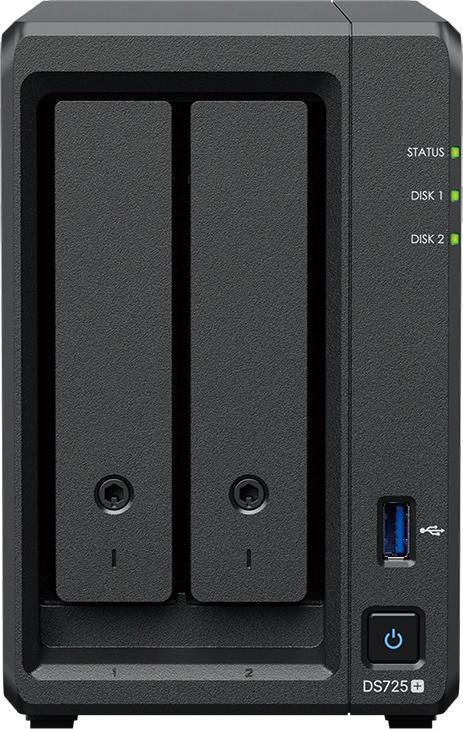
The two-bay NAS is the box people keep underestimating. It’s the entry-level shelf, the “starter unit” — and then a Synology DS725+ lands on the bench, and you realize it has ECC memory, two M.2 NVMe slots, dual 2.5GbE, and an expansion port that takes it to seven bays. For a small office, a home lab, or an edge site, this little chassis does most of what the big towers do at a fraction of the footprint. I’ve been specifying these into client sites, and here’s the installer’s take.
What the DS725+ actually is
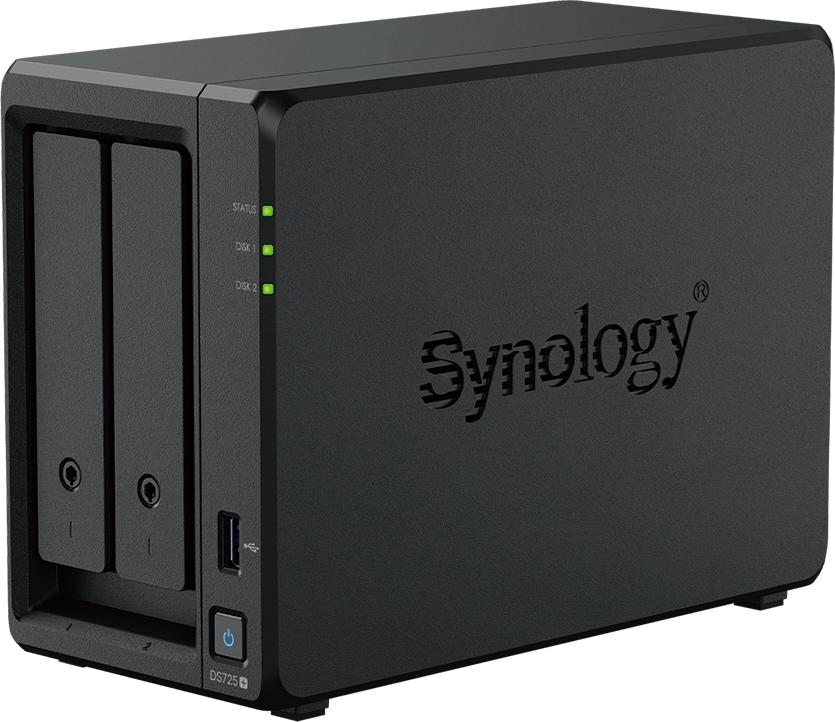
The DS725+ is Synology’s current 2-bay Plus-series DiskStation: same Ryzen platform and ECC memory policy as its bigger siblings, shrunk into a desktop chassis barely bigger than a shoebox. There’s also a DS725neo+ twin — identical hardware except it ships with non-ECC memory, and that’s really the only difference on the spec sheet. Both share the same board, same power supply, and same software feature set running DSM.
The pitch is “compact and capable storage for home, small business, and edge,” and Synology bills it as a backup target, a file server, an NVR, and a private cloud all at once.
Specs, straight from Synology
| Item | DS725+ | DS725neo+ |
|---|---|---|
| CPU | AMD Ryzen R1600, 2 cores / 4 threads, 2.6 GHz base / 3.1 GHz turbo, 64-bit | AMD Ryzen R1600, same |
| Memory | 4 GB DDR4 ECC SODIMM (2 slots, up to 32 GB) | 4 GB DDR4 non-ECC SODIMM (2 slots, up to 32 GB) |
| Drive bays | 2× 3.5″/2.5″ SATA + 2× M.2 2280 NVMe | Same |
| Max capacity w/ expansion | 7 bays (DX525 ×1), up to 168 TB raw with 24 TB drives | Same |
| Network | 1× 2.5GbE + 1× 1GbE RJ-45 | Same |
| Expansion port | 1× USB Type-C (for DX-series expansion unit) | Same |
| Performance (Synology internal test) | Up to 276 MB/s read / 224 MB/s write | Same |
| File system | Btrfs or ext4 internal | Same |
| Noise | 17.9 dB(A) idle, single 92 mm fan, Cool/Quiet modes | Same |
| Power | 65 W adapter; 20.41 W access / 7.87 W HDD hibernation | Same |
| Size / weight | 166 × 106 × 223 mm, 1.51 kg | Same |
Two notes from the fine print that matter on real jobs: the M.2 slots are cache-capable and support SSD storage pools, but hot-swap does not apply to them — the trays are for the SATA bays. And Synology wants Synology-branded memory for the second slot if you want the warranty to stay whole.
The software is the product
Per Synology’s own spec page, what you get with DSM on this box includes Btrfs snapshot protection — 256 snapshots per shared folder, 32 per LUN, 2,048 system-wide, with Snapshot Replication to a second box. File services cover SMB, AFP, NFS, FTP, WebDAV and Rsync, with Windows ACL integration and NFS Kerberos. There are 32 iSCSI targets / 64 LUNs with LUN clone/snapshot and Windows ODX, which means it can honestly serve as a small VMware or Hyper-V target.
Synology lists it for backing up PCs, phones, and cloud apps, running Synology Drive sync-and-share, and running Surveillance Station with support for over 8,700 IP camera models (two licenses included, paid add-ons beyond that — and Hybrid Share plus C2 services need a subscription). The headline number for this model is 40 IP cameras: a 2-bay box that’s a legitimate small-site NVR is exactly the kind of consolidation clients love.
Pros
- ECC standard on the Plus line. Btrfs data scrubbing plus ECC is the reason to buy a Plus model over the cheaper consumer units. If a client is storing primary data, this is the minimum spec I’ll put on paper.
- Dual 2.5GbE out of the box. Link-aggregation-capable. Most 2-bay boxes in this class still give you a single gigabit port, which caps you at ~110 MB/s and makes the NVMe cache a decoration.
- Two M.2 NVMe slots. Cache or storage pool, and they don’t eat bays — on a 2-bay unit that’s everything.
- DX525 expansion to seven bays. One USB Type-C expansion port, up to 168 TB raw with 24 TB drives. A “starter” NAS that grows past most people’s needs.
- Quiet enough for an office. 17.9 dB(A) idle measured by Synology — you can keep this on a desk, not in a mechanical room.
- Snapshot + replication + iSCSI + surveillance licensing model that undercuts the enterprise brands’ per-seat math.
Cons
- Two bays, period. A RAID-1 mirror is two drives, so your “expansion to seven bays” only happens if you buy the DX525 — budget it up front or you’re growing into a two-drive mirror with no breathing room.
- M.2 slots aren’t hot-swappable. Fine for set-and-forget cache; annoying when a drive fails at year three and the unit is behind a rack shelf.
- Single external drives on USB are second-class. ExFAT/NTFS external support exists, but the expansion architecture is the DX525, not a USB shelf.
- The DS725neo+ drops ECC. If the client needs Btrfs data integrity the way I like to sell it, that’s the only reason to pay for the plus over the neo.
- Hybrid Share / C2 features need a subscription — fine, but it should be priced into the quote, not discovered later.
Where I’d actually put one
Small office file server / backup target. Two 8 TB drives in SHA/Zenith mirror + the second RAM slot filled to 16 GB gives you SMB with Windows ACLs, snapshots several times a day, and Snapshot Replication pushing to a second DS725+ offsite. That’s a three-site data protection plan for very little money and roughly the desk space of a thick book.
Edge sites and shops. Fourteen cameras on Surveillance Station, recording over 2.5GbE, with NVMe cache smoothing the random writes — this is the classic small commercial install, and the 17.9 dB idle noise means it can live in the back office instead of a locked rack.
Home lab and creator storage. The ECC + Btrfs + iSCSI combo makes it a legitimate ESXi target or a Lightroom/Resolve scratch-and-archive box, especially with the second M.2 slot as read-write cache. For straight video editors, the single 2.5GbE ceiling (~276 MB/s read) is the honest limitation — it’s a project-drive speed, not an editing-array speed.
Bottom line
The DS725+ is the best value on Synology’s Plus lineup for anyone whose storage story is “two drives now, maybe seven later.” ECC, dual M.2 NVMe, link-aggregated 2.5GbE, and the full DSM feature set in a 1.5 kg quiet box is a legitimate answer to most small-business storage problems. Buy the DX525 in the same quote if the data will matter in three years, max the RAM on day one, and put Synology drives in both bays so the warranty story stays clean. If you don’t need ECC and the surveillance/backup licensing math works anyway, the DS725neo+ is the identical box at a better price.
Specifications and feature claims sourced from Synology’s official DS725+/DS725neo+ product and specification page (synology.com); product renders are Synology imagery. Performance figures are Synology internal-test numbers.
Need help sizing a Synology build for a site? Get in touch.