
Ubiquiti USW-Pro-XG-24-PoE Review: The All-PoE+++ Multigig Switch That Justifies the Pro Tier
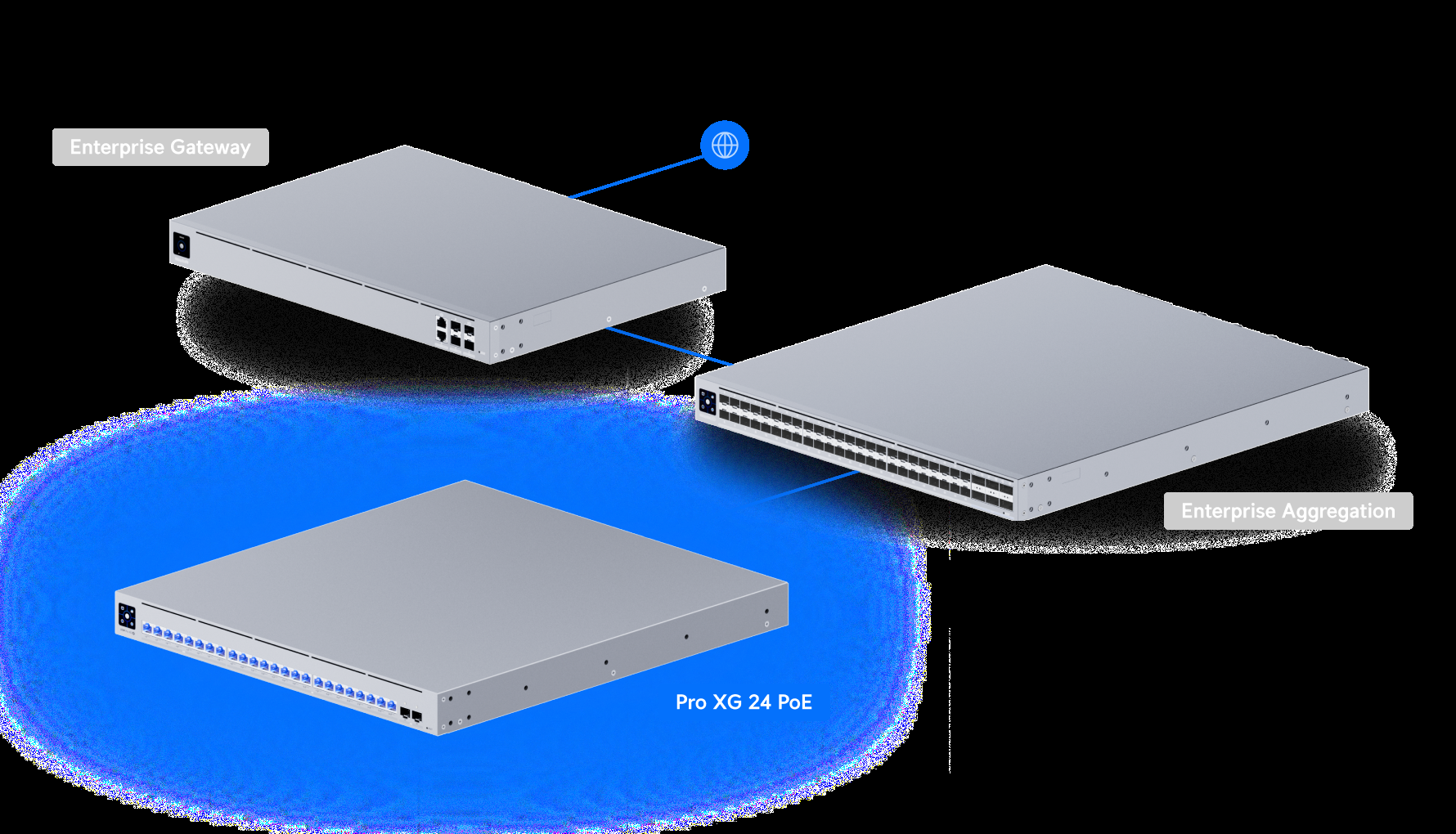
Most of my rack builds start with a Dream Machine and end with whatever PoE switch was on the shelf at the distributor. That’s fine until the day a client asks for 10G to the workstation, a WiFi 7 AP that actually wants a multigig uplink, and a camera wall that refuses to share buffer with anything else. That’s the room the Ubiquiti UniFi Pro XG 24 PoE (USW-Pro-XG-24-PoE) is built for. It’s Ubiquiti’s professional-tier Layer 3 access switch with a mix of 10G and 2.5G copper that finally matches what real installations are plugged into, and it does it without a full edge-switch fork in management style.
What it is
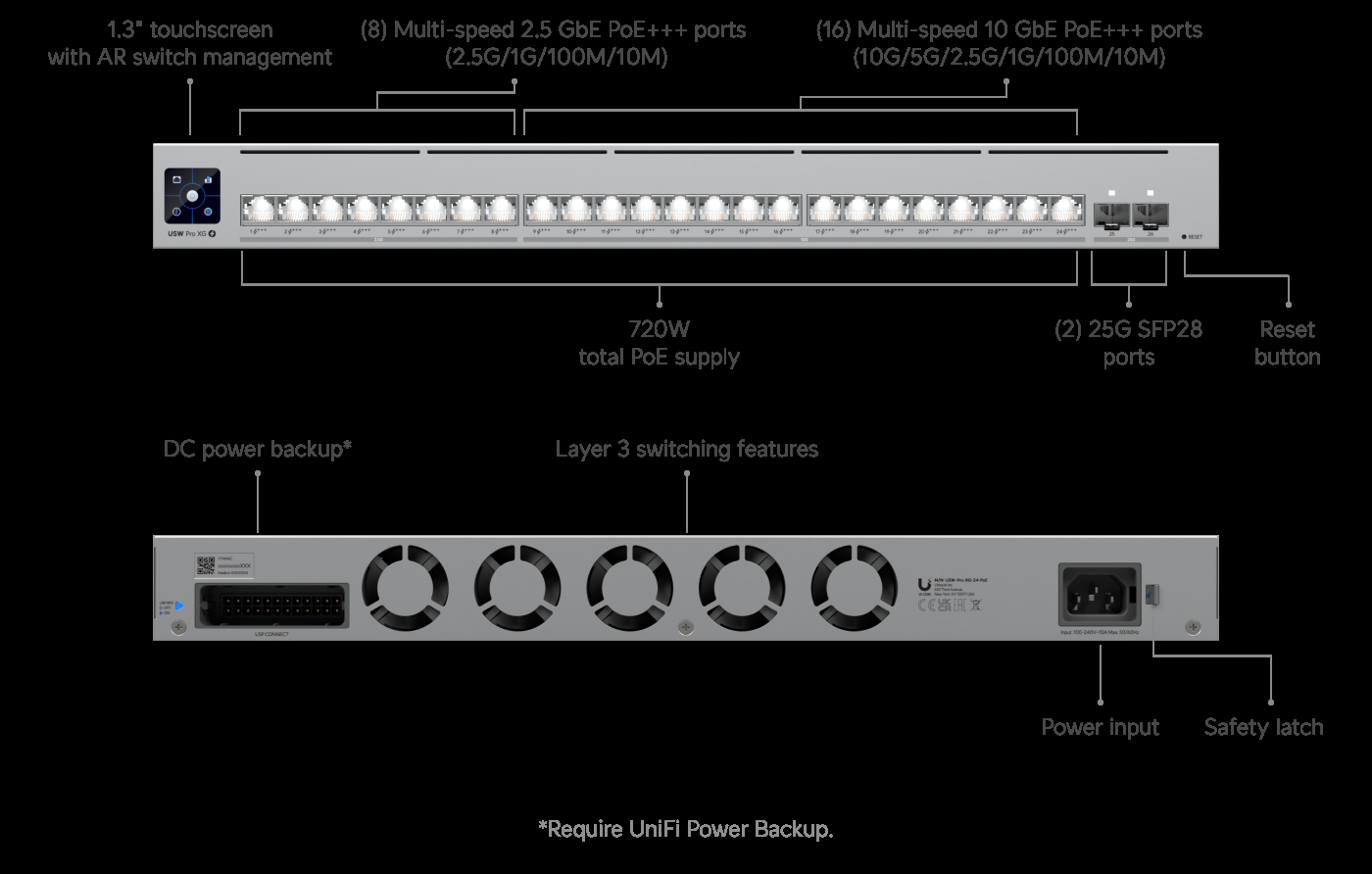
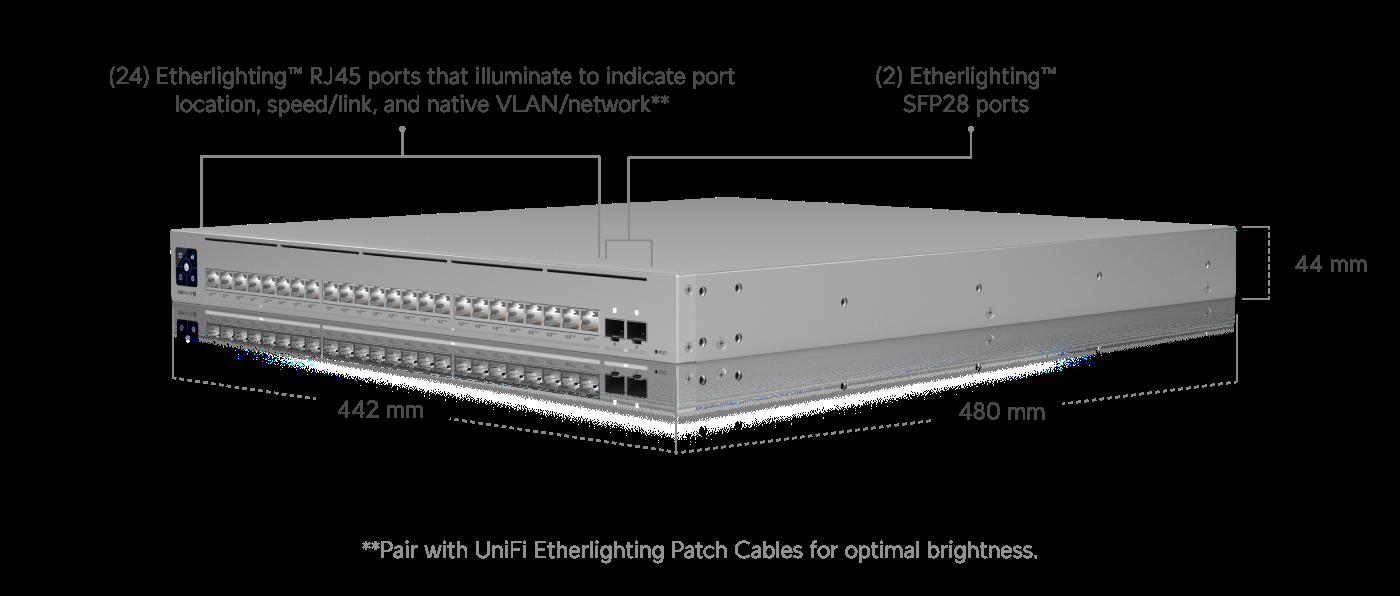
The USW-Pro-XG-24-PoE is a 1U rack-mount Layer 3 switch from Ubiquiti’s professional UniFi switching line, managed through UniFi Network (application requirement is version 9.1.120 or later). The port layout is where this switch earns its keep: sixteen 10GBASE-T RJ45 ports, eight 2.5GBASE-T RJ45 ports, and two 25G SFP28 uplinks. Every single copper port supports PoE+++ — up to 90W per port — with a total PoE budget of 720W. That combination (all-copper multigig access layer, full PoE+++, 25G uplinks) is unusual at this price point; most vendors make you choose between the copper ports and the power budget, or push 10G clients into SFP+ cages with modules that run hot.
The SFP28 ports are backward compatible at 25G/10G/1G, and the multigig RJ45 auto-negotiate down the full stack (the 10G ports handle 10G/5G/2.5G/1G/100M/10M, the 2.5G ports handle 2.5G/1G/100M/10M), so you can drop this into a mixed environment today and grow into it. Ubiquiti rates it at 460 Gbps switching capacity, 230 Gbps total non-blocking throughput, and 342 Mpps forwarding rate, with an 8 MB packet buffer, a 32,000-entry MAC table, 1,000 supported VLANs, and 512 static routes. For an access-layer switch that’s comfortable headroom; the buffer is notably larger than what Ubiquiti’s non-Pro line offers.
Verified specifications
| Spec | USW-Pro-XG-24-PoE |
|---|---|
| Ports | 16x 10GbE RJ45 + 8x 2.5GbE RJ45 + 2x 25G SFP28 |
| PoE | PoE+++ on all 24 copper ports (up to 90W/port) |
| Total PoE budget | 720W |
| Switching capacity | 460 Gbps |
| Non-blocking throughput | 230 Gbps |
| Forwarding rate | 342 Mpps |
| Layers / routes | Layer 3; 512 static routes, 1,000 VLANs, 32K MAC table |
| Buffer | 8 MB |
| Power | Internal 870W AC/DC PSU + DC power backup input (USP RPS) |
| Max power draw | 150W idle-equivalent + PoE output (870W total) |
| Display | 1.3″ touchscreen (Etherlighting) |
| Form factor | 1U rack mount, SGCC steel, ~8 kg with brackets |
| Rack depth | 19″ four-post, 600–1,066 mm post depths |
| Operating range | -5 to 40°C, 10–90% non-condensing |
| Management | UniFi Network 9.1.120+ |
| ESD protection | Air ±30kV, contact ±20kV |
| Compliance | NDAA; CE, FCC, IC, Anatel |
Layer 3 features that matter on a job
Ubiquiti lists full inter-VLAN routing with local DHCP server and DHCP relay on this switch, plus static routing. On a single-switch site that means the core functions you’d normally pay a router for live in the switch itself — handy for IDF closets where a gateway in the MDF would mean an extra run and an extra failure domain. On the Layer 2 side it has the list I actually use: LACP, STP/RSTP, IGMP snooping with advanced querier/fast-leave/router-port configuration, 802.1X control, DHCP snooping and guarding, port mirroring, storm control, egress rate limiting, MAC- and IP-based ACLs, voice VLAN, LLDP-MED, and jumbo frames.
The one line item that caught my eye as an integrator: prebuilt Pro AV profiles for Play, Dante, Q-SYS, NDI, SDVoE, Shure, and AES67. If you do AV-over-IP rooms, you know the usual routine of hand-tuning QoS and IGMP for each protocol stack. Having those profiles shipping native — rather than a wiki page of recommended settings — is the kind of thing that saves you an hour of support calls per site, and it tells you Ubiquiti intends this switch to sit in pro AV racks, not just IT closets.
Real install notes
Cable length is the invisible tax on any all-copper multigig switch. Every 10GBASE-T run wants Cat6A terminate properly, and the 10G ports putting out PoE+++ means longer runs eating more budget as heat at the switch end. This chassis is 480 mm deep — spec your rack before you spec this switch, because shallow six-post wall racks will swallow it.
Thermal reality: 16 ports of 10G PoE in 1U means this thing has real airflow requirements. The -5 to 40°C operating range is fine for conditioned racks; a non-climate-controlled utility room in August is where 90W PoE+++ devices go to throttle. Keep the front and rear clearance honest.
The dual power architecture (internal 870W supply plus a DC backup input for Ubiquiti’s USP-RPS) is the feature that makes this defensible in a single-switch core. When the RPS fails over, it’s covering the whole PoE load, not just the board. Budget it in the rack.
And Etherlighting — the 1.3-inch touchscreen plus port LEDs you can map to your topology in UniFi Network — sounds like a gimmick until hour six of a troubleshooting session and you trace the right cable by the flashing port instead of by label.
Pros and cons
Pros:
- All 24 copper ports do PoE+++ at 90W with a 720W budget — nothing else in the UniFi lineup has the same full 10G/2.5G split with full power on every port.
- True Layer 3 (inter-VLAN routing, DHCP server/relay, 512 routes), not the half-featured “L2+” management of the Pro line.
- 25G SFP28 uplinks future-proof the core connection without SFP+ guesswork.
- Native Pro AV profiles (Dante, Q-SYS, NDI, SDVoE, AES67, Shure) out of the box.
- Redundant DC power input plus UniFi’s mature single-pane management and Etherlighting.
- NDAA compliant, which clears most government/Schools procurement boxes.
Cons:
- 480 mm deep and 1U dense with heat — shallow racks and unconditioned closets are hostile territory.
- Requires UniFi Network 9.1.120+; shops still standardizing on older controllers or self-hosted builds need to check their version first.
- All-copper multigig means 10GBASE-T power/heat on client ports; SFP28-only rivals run cooler per port.
- Management is UniFi-only — no standalone CLI for the old-school crowd.
Bottom line
The USW-Pro-XG-24-PoE is the easiest switch in the UniFi catalog to justify when a site has genuinely outgrown the Pro line. For mixed-tenant buildings, AV-integrator racks, or any install with a dozen cameras, several WiFi 7 APs, and a workstation or two on 10G, the “all 24 ports PoE+++, 16 of them at 10G” answer is clean. If your site is all 1G access with maybe two multigig uplinks, save the money and buy the Pro XG’s cheaper siblings with the budget you kept. But when your port map already looks like this switch’s spec sheet, you’re buying the right box on the first pass — that’s worth more than a bargain at the wrong tier. If you want help sizing an access layer for a specific site, get in touch.
Specifications verified from Ubiquiti’s official techspecs page for the USW-Pro-XG-24-PoE. Product images are official Ubiquiti imagery (white space cropped).