
Synology RS6426xs+ Review: the 16-Bay Xeon Rack NAS That Outgrew the Tower Line
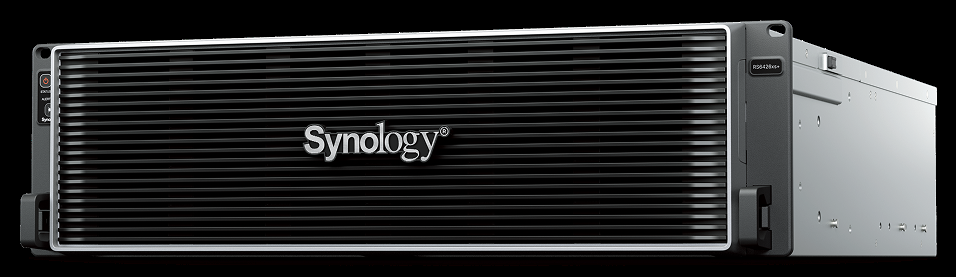
Most integrators treat Synology’s rack line as the big-sibling tax — same product, more rack ears, bigger invoice. The RS6426xs+ broke that habit for me. It’s the newest head of the 60-series: a 3U, 16-bay Xeon machine with dual 10GbE on board, six ECC memory slots, and a path to 64 bays of expansion. If you spec racks for a living, this box sits in an awkward and interesting spot between the tower-class Plus units everyone knows and the four-figure xs+ flagship fleet. Here’s the full verified spec sheet, where it shines on real jobs, and where it doesn’t.
What the RS6426xs+ actually is
The RS6426xs+ is Synology’s newest 3U RackStation at the head of the 60-series. Think of it as the consolidation box: one chassis that can front a file server, a VMM host, an iSCSI SAN, a backup target, and a Surveillance Station recorder without any single role starving the others. The specs below are quoted straight from Synology’s official product page — nothing rounded, nothing invented.
Verified specifications
| Item | Synology RS6426xs+ |
|---|---|
| CPU | Intel Xeon D-1739, 8 cores / 16 threads, 3.0 GHz base / 3.5 GHz turbo, 64-bit, hardware encryption engine |
| Memory | 16 GB DDR4 ECC RDIMM pre-installed (1× 16 GB), 6 DIMM slots, up to 96 GB (16 GB × 6) |
| Bays | 16 × 3.5″ SATA HDD or 2.5″ SATA SSD, hot-swappable; up to 64 bays with 4 × RX1225RP expansion units |
| Network | 2 × RJ-45 10GbE LAN, 1 × dedicated out-of-band management LAN port |
| Expansion | 2 × PCIe Gen4 x8 slots (x8 link); 4 × Mini-SAS HD expansion ports; 2 × USB 3.2 Gen 1 |
| Form factor | 3U, 132.3 × 482 × 656.5 mm, 17.9 kg; 4-post 19″ rack (RKS-02 rail kit, sold separately) |
| Cooling / power | 3 × 80 mm easy-replacement fans; 550 W PSU with redundant power supply support; 165.45 W measured access / 73.38 W HDD hibernation; 42.2 dB(A) |
| RAID | Btrfs; RAID F1, Basic, JBOD, 0, 1, 5, 6, 10; migration Basic→1, Basic→5, 1→5, 5→6; expansion by adding drives on RAID F1/JBOD/5/6 |
| Scale limits | Max single volume 1 PB (needs 64 GB RAM, RAID 6 groups only) / 200 TB (32 GB RAM) / 108 TB; 32 internal volumes max |
| File services | SMB/NFS/AFP/FTP/WebDAV/Rsync; 3,200 max SMB connections (FSCT-tested); NTFS ACL integration; NFS Kerberos |
| SAN | 256 iSCSI targets / 512 LUNs; LUN clone/snapshot; Windows ODX |
| Virtualization | VMware vSphere through ESXi 8.0 U2, Hyper-V on Server 2025, Citrix XenServer 8.4, OpenStack Cinder; VMM recommended 16 VM instances / 16 virtual DSMs |
| Surveillance Station | 2 licenses included; max 285 channels / 8,550 FPS (H.265 1080p); 120 channels at 4K H.265 |
| Data protection | Snapshot Replication up to 65,536 snapshots per system; Hyper Backup; Active Backup for Business; Storage Manager dedupe/compression |
| Users | 10,240 local accounts, 512 shared folders; Synology Drive 5,900 users; MailPlus 6,800 users |
| Warranty | 5 years (from purchase date) |
What jumps off the spec sheet
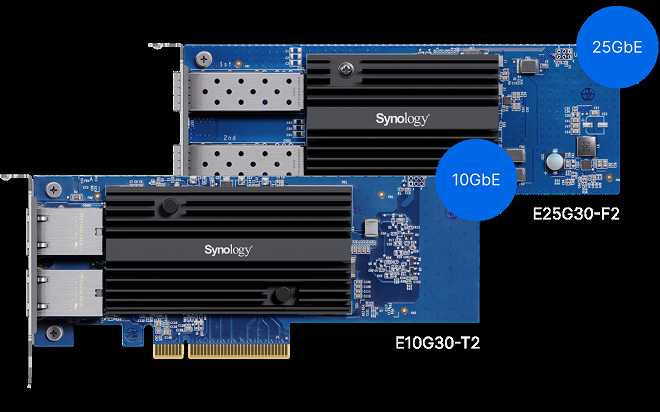
Two real 10GbE ports standard. Not one, not 2.5G. Dual 10GBASE-T plus a dedicated out-of-band management port means you can separate production and management VLANs properly on day one, the way you’d spec any enterprise array — without spending $200 on add-in cards on top of the base unit.
ECC memory is standard, and there are six slots. 16 GB DDR4 ECC RDIMM in the box, expandable to 96 GB across six DIMMs. This matters for more than bragging rights: Synology’s own 1 PB single-volume figure requires 64 GB of memory and RAID 6 groups only. If you’re building a petabyte-class volume, the machine shows up with one third of the RAM it needs and five empty slots waiting. That’s an intentional architecture, not an upsell trap.
Sixteen bays with a legitimate growth path. 16 drives native, 64 with four RX1225RP expansion shelves on four Mini-SAS HD ports. Note the expansion shelves are the RP (redundant-power) variants — good, because a 48-drive shelf on a single brick PSU would make me nervous.
25GbE-ready PCIe. Two Gen4 x8 slots. A pair of E25G30-F2 cards takes this to 25 gig without touching the onboard ports. If your core just went 25G on the aggregation layer, this box keeps up on both legs.
Where it fits in the Synology rack lineup
Honestly? It complicates the lineup, and I mean that as a compliment. The RS4021xs+ was the old big-daddy at 12 bays; the RS6426xs+ gives you sixteen for the same general bracket and a newer Xeon D. The RS826+ and RS1226+ are one-and-two-cable-friendly towers-in-rack-clothing with less CPU and fewer PCIe lanes. If your job is “simple rack NAS, four drives, quiet-ish,” buy the smaller box. If your job is “this box is the only storage device in the building,” count bays — and 16 is a very convenient number.
Install notes from the field
Buy the rail kit. Then buy the right one. The RS6426xs+ officially supports the RKS-02 sliding rails, sold separately. For a 3U chassis at just under 18 kg loaded — call it 25–30 kg with enterprise spins in every bay — do not be the installer who rack-mounts with brackets and prayers. Sliding rails mean you can service a drive or a DIMM without a second person and a flashlight in your mouth.
Thermal math. 165 W access, 42.2 dB(A) at a meter. In a comms closet with a drop ceiling that number will bother someone; in a proper 4-post rack in a mechanical room it disappears. Plan for the noise before the customer discovers it.
Memory strategy. Synology’s own notes are blunt: they won’t honor full warranty/support on third-party RAM, and multi-module configs must be identical modules. With six slots that’s up to six matching D4ER02-16G modules. Quote the Synology RAM in the BOM up front; it’s cheaper than the conversation about warranty later.
Drive compatibility is mandatory. Synology will tell you to consult the compatibility list before buying drives, and on the enterprise line that means HAT5300-series SATA spins, SAT5200 SSDs, or the SNV5420 NVMe cache drives. On mixed shops this is the line item that wins you the project honestly — budget it and tell the client why.
Real-world use cases
Consolidated SMB file + backup + surveillance. 3,200 SMB connections FSCT-tested, 285 H.265 channels for Surveillance Station, Active Backup for business PCs and VMs, and snapshot replication out to a DR site. One box, one UPS circuit, one license conversation.
Virtualization host on a budget. 16 recommended VM instances with ECC RAM and 25GbE capability is a very different class of hypervisor than anything else in DSM-land. ODX support and 512 LUNs make it a legitimate entry SAN for a hyperconverged-curious shop.
The petabyte play. Fill 16 bays, hang four RX1225RP shelves, populate memory past 64 GB, format RAID 6 and you’ve got a single PB volume on a Synology box with dual 10G — for considerably less than any traditional array quote I’ve signed this year.
Pros and cons
Pros
- Dual native 10GbE + dedicated OOB management port
- 16 bays standard, 64 max — the biggest current Synology rack head
- ECC RDIMM standard, six slots, 96 GB max
- Two PCIe Gen4 x8 slots — 25GbE ready
- RX1225RP expansion shelves carry redundant power
- 5-year warranty; FSCT-tested 3,200 SMB connections
- RAID F1/6/10, snapshot max 65,536, ODX
Cons
- Rail kit (RKS-02) sold separately — do not skip it
- Synology-only memory policy for full warranty support
- 1 PB volume needs 64 GB RAM and RAID 6 only — the 16 GB you ship with isn’t enough for the headline number
- 42 dB(A) is rack-room noise, not office noise
- Redundant power supply support (550 W; 165 W measured access power)
Bottom line
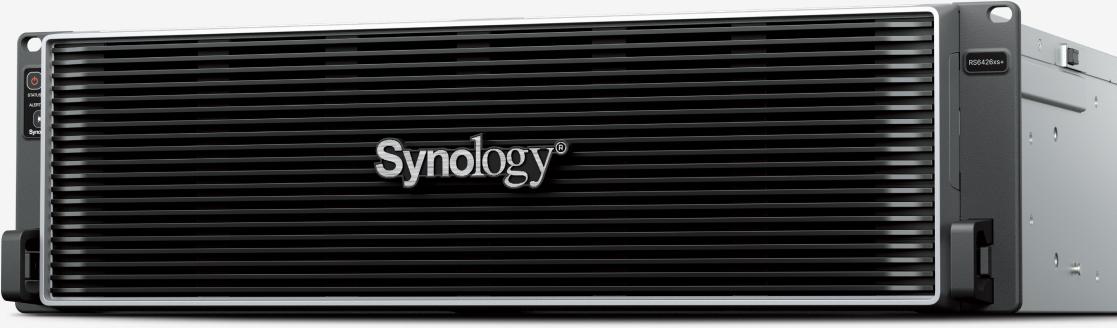
The RS6426xs+ is what happens when Synology stops pretending their rack line is just towers with ears. Xeon D with hardware encryption, six ECC slots, dual 10G, a 64-bay growth path on redundant-power shelves, and a five-year warranty make it the consolidation box I’d actually spec for a fifteen-to-forty-seat job that needs file, backup, surveillance, and a few VMs in one chassis. It doesn’t need to be the flagship — it just needs to be the last Synology box you ever spec twice. If you’re building one out, get in touch and I’ll help you size the bays, the memory, and the UPS circuit before the rails ever hit the rack.
Specifications and product imagery sourced from Synology’s official RS6426xs+ product page (synology.com), verified November 2026. All images courtesy of Synology.