
Synology RS826+ Review: The Quiet 1U Rack NAS With ECC, Four GbE Ports, and a 25GbE Upgrade Slot
The Synology RS826+ is the box I hand to the customer who says "it has to live in a rack" but doesn’t need a full enterprise storage platform. Four bays, one rack unit, ECC memory standard, four Gigabit ports on the back, and a clear path to eight bays and 25GbE when the day comes that it matters. In a lineup where Synology has been pushing everything toward 2.5G and 10G on the tower side, the RS826+ is interesting precisely because it doesn’t pretend to be something it isn’t — it’s a compact edge and remote-office workhorse, and it does that job better than a tower shoehorned into rails.
All specs below are pulled straight from Synology’s official product page for the RS826RP+/RS826+.

Verified specifications (RS826+ vs RS826RP+)
| Item | RS826+ | RS826RP+ |
|---|---|---|
| CPU | AMD Ryzen V1500B, 4 cores / 8 threads, 2.2 GHz, 64-bit, hardware encryption engine | |
| Memory | 4 GB DDR4 ECC SODIMM, 2 slots, max 32 GB (16 GB × 2) | |
| Drive bays | 4 × 3.5" SATA HDD or 2.5" SATA SSD, hot-swappable | |
| Max bays w/ expansion | 8 bays with one RX426 expansion unit | |
| Network | 4 × 1GbE RJ-45 (link aggregation / failover supported) | |
| PCIe | 1 × Gen3 x8 slot (x4 link) — supports 10/25GbE upgrade cards | |
| USB / expansion port | 2 × USB 3.2 Gen 1, 1 × USB Type-C expansion port | |
| Form factor | 1U rack (4-post 19", rail kit RKM114/RKS-02 sold separately) | |
| Size | 44 × 480 × 492.6 mm, 6.4 kg | 44 × 480 × 518.6 mm, 8.0 kg |
| Fans | 3 × 40 mm | 2 × 40 mm |
| Noise level | 26.5 dB(A) | 41.2 dB(A) |
| Power supply | 150 W adapter (37.73 W access / 15.57 W hibernation) | 150 W redundant (46.07 W access / 20.10 W hibernation) |
| SSD cache | Supported with select compatible SSDs (with DSM storage pooling) | |
| Warranty | 3 years, extendable to 5 | |
Two things jump out at me when I read that table as an installer. First: ECC memory is standard at this tier, four cores of Ryzen silicon, and both model variants share the same board. The RP in RS826RP+ buys you a redundant power supply and a slightly deeper chassis — that’s the whole split. Second: the network out of the box is four 1G ports, not 2.5G. On a Plus-line tower like the DS1525+ you get 2.5G standard, so Synology is explicitly positioning this as a bonded-link and failover box, with the PCIe slot as your upgrade hatch.
Networking: four legs before you spend on a NIC
Four Gigabit ports that bond for link aggregation and automatic failover is an underrated feature in a box this size. For a remote office with a bunch of cameras, file shares, and a VoIP server pointing at it, LACP failover across four links means a single switch uplink or cable failure doesn’t take the storage offline. Load balancing spreads sessions, not a single giant transfer, so a lone iSCSI LUN still tops out near 110 MB/s — know what your workload is before you promise throughput.
When the bonded pipes stop being enough, the Gen3 x8 slot (wired as x4, so roughly 3.9 GB/s theoretical) takes Synology’s E10G21-F2 style 10GbE cards or 25GbE options per the compatibility list. That slot is also the only expansion path on the box — no internal M.2 cache sockets on this model, so cache SSDs go in the drive bays. Budget a bay for cache or buy the expansion unit before you need it, because running a four-bay NAS at four-bay capacity means no cache volumes.
Active/passive pairing is the other network-side story: two RS826+/RS826RP+ units can be clustered with Synology High Availability for automatic failover. Two of these plus a switch port each is a genuinely affordable HA pair for a small server room — the RP variant exists exactly so the primary stays up through a PSU failure.
Storage and the RX426 math
Four bays native, eight with one RX426 expansion. With current SATA drives that’s up to 192 TB raw on Synology’s own numbers for the expanded config, which is plenty for endpoint backup archives, Surveillance Station, or the accounting department's entire file life. Synology's Active Backup for Business covers Windows, Mac, Linux endpoints plus VMware and Hyper-V VMs with dedupe and no per-agent licensing — the licensing model is what wins these deals, and it's worth saying out loud in a quote that the competitor charges per protected server.
SSD caching needs compatible SSDs and eats either bays or the expansion unit, and Synology's drive compatibility list is mandatory reading before you order disks on this platform. Immutable snapshots (WORM-style anti-ransomware protection) carry over from DSM, which is exactly what a backup target should have.
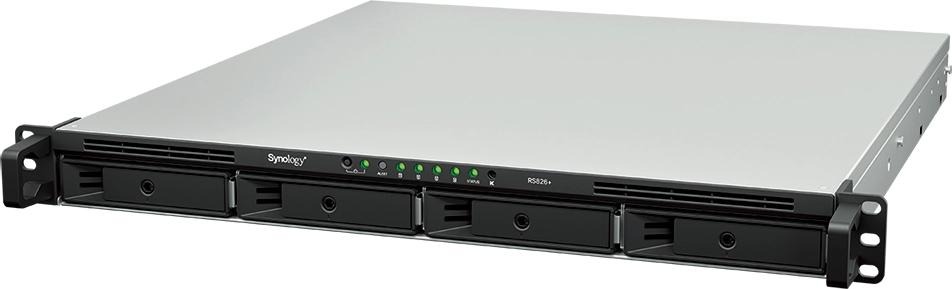
Where this thing actually lives
Installer note: the RS826+ is 492.6 mm deep and the RP is 518.6 mm — both fit a standard 4-post rack, but the rails are sold separately (RKM114 or RKS-02), and I size 600 mm+ depth racks whenever the RP variant is on the BOM so cable management behind a redundant PSU isn't a puzzle.
- Remote offices and light-edge server rooms. This is the target market Synology states outright, and the noise numbers show it: 26.5 dB(A) for the RS826+ is library-quiet territory, while the RP with redundancy runs 41.2 dB(A). If the box shares air with people, the non-RP model is the default; if it shares a rack with a switch that sounds like a hair dryer, redundancy wins.
- VMware/Hyper-V backup targets. Four cores plus ECC plus Active Backup with dedupe makes it a proper backup appliance. Pair with a second unit or C2 for 3-2-1.
- Surveillance Station head-end on Synology hardware. Official support is up to 40 IP cameras. Cameras like a box that doesn't blink — if that box is also your file server, bond the NICs and put the VMs' iSCSI on its own VLAN.
- Hàa two-unit HA pair for a small office. Synology High Availability active/passive on two RS826s at street price costs less than many single enterprise SANs do.
Pros and cons
Pros:
- ECC memory standard, Ryzen V1500B quad-core Eight threads with hardware encryption
- Four bonded GbE ports with failover built in
- PCIe Gen3 slot for 10/25GbE upgrade — top of the Plus line's upgrade path in 1U
- Active/passive HA pairing with a second unit
- Genuinely quiet at 26.5 dB(A) (non-RP)
- Licensing model included: Active Backup, Active Insight, CMS, Surveillance Station platform, immutable snapshots
Cons:
- Only 1G onboard NICs while the tower line has moved to 2.5G — upgrade costs a PCIe card
- No internal M.2; SSD cache consumes bays
- Expansion caps at one RX426 (8 bays) — outgrow it and you jump product lines
- Rail kit sold separately, as usual
- RP variant is noticeably louder (41.2 dB(A)) with the second PSU and fewer fans
Bottom line
The RS826+ is Synology's answer to "I need a rack NAS with ECC, real backup software, and a path to 25GbE, but I don't need sixteen bays." The four bonded GbE ports, PCIe upgrade slot, HA pairing, and quiet operation make it the easy default for small server rooms and light edge deployments — pick the RS826RP+ only when a power supply failing is an outage, not an inconvenience. If you need 2.5G native or M.2 cache in a tower, stay with the DS1525+/DS1825+ line; if you need this in a rack with room to grow, this is the one. Need help sizing one for a site? Get in touch.
Source: specifications and product imagery courtesy of Synology Inc. official product page (synology.com/products/RS826+).