
Synology FS3410 Review: The 24-Bay All-Flash Box That Crashes the Entry-Array Party
Most shops treat Synology as the box under the desk. But when a client’s workload crosses into all-flash territory — VM clusters, database services, video post houses pulling huge files over SMB — Synology has a rack product line that most of the “real storage vendor” quotes never price against: the FlashStation FS3410.
I spent a week with the spec sheet before a quote went out, and it’s an unusual animal: a 24-bay, all-SAS-backend, purely-SSD 2U that still runs the same DSM you already know how to administer. Here’s the full verified picture, where it wins, and where it earns its keep versus the tower line.
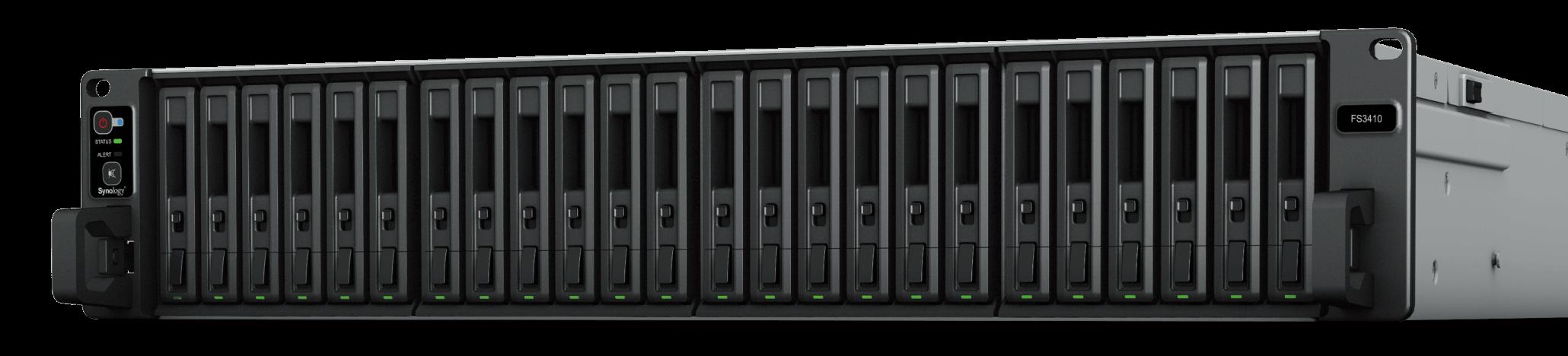
Verified specifications (Synology official spec page)
| Item | Synology FS3410 |
|---|---|
| Form factor | 2U rackmount, 88 × 482 × 724 mm, 15.0 kg |
| Drive bays | 24 × 2.5″ SATA SSD (hot-swap), Synology SAT5200 enterprise series |
| CPU | Intel Xeon D-1541, 8 cores / 16 threads, 2.1 GHz base / 2.7 GHz turbo, 64-bit, hardware encryption engine |
| Memory | 16 GB DDR4 ECC RDIMM pre-installed (1 × 16 GB), 4 slots, max 128 GB (32 GB × 4) |
| Networking | 2 × 10GbE RJ-45, 4 × GbE RJ-45, 1 × dedicated out-of-band management port, up to 15 LAN ports total; 2 × PCIe 3.0 x8 slots accept 10/25/40GbE NICs (E25G30-F2, E10G30-F2/T2) |
| Performance (Synology lab) | Over 356,500 / 129,400 iSCSI 4K random read/write IOPS |
| Power | Redundant PSUs (2 included), 550 W, ~113.8 W access draw |
| Cooling / noise | 4 × 80 mm hot-swap fans, 46.1 dB(A) idle, Full-Speed/Cool/Quiet modes |
| Other I/O | 2 × USB 3.2 Gen 1, console/serial port, status + alert indicators, mute button |
| RAID | SHR/RAID F1, 0/1/5/6/10, Btrfs with volume-wide dedup on flash volumes (Synology measured 3.15:1 across 10 test VMs) |
| HA & virtualization | Synology High Availability active-passive pairing, iSCSI SAN Manager, certified for VMware vSphere, Hyper-V, Citrix XenServer, Kubernetes CSI driver; VMM/Virtual DSM (1 license included) |
| Backup suite | Unlimited free VMware/Hyper-V backups via Active Backup for Business; Snapshot Replication RPO down to 5 minutes; Hyper Backup |
| Warranty | 5 years limited (rack kit RKS-02 sold separately) |
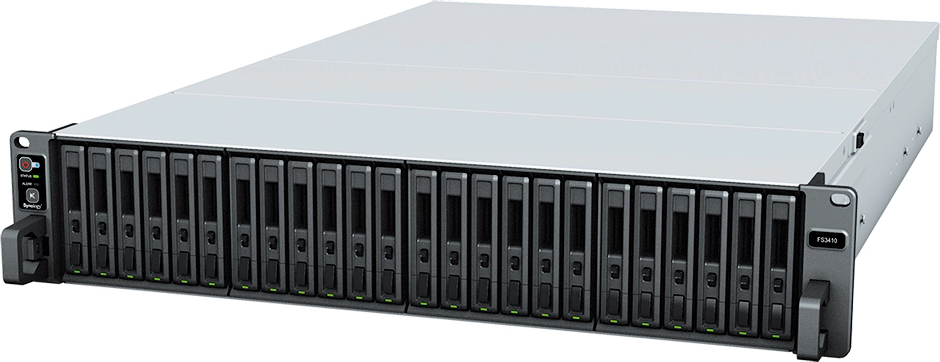
What it actually is
The FS3410 is Synology’s flash-native big brother to the Plus-series towers. The bays take 2.5-inch SATA SSDs only — this is not a box you stuff with spinning rust to save money. The payback for that discipline is in the IOPS number above: a quarter-million-plus random 4K reads lands it in territory where you’d normally expect an entry all-flash array from the big-name vendors, at a fraction of the sticker, and running DSM instead of a storage OS you need a certification to configure.
The other things that separate it from the tower line: ECC registered memory standard with four slots to 128 GB, dual power supplies in the box (not an option), a dedicated out-of-band management port so you can get logs off a powered-down box without a keyboard, and two PCIe 3.0 x8 slots so the 10GbE ports were never meant to be the ceiling — 25GbE NICs are an official accessory.
Where I’d spec it
VM storage for small clusters. Three ESXi hosts, a dozen VMs, and no budget for a SAN with per-terabyte licensing. iSCSI LUNs through SAN Manager, snapshot replication at a five-minute RPO, and vCenter-integrated recovery do the job without a storage certification on the wall.
Creative shops pulling large files. Video post, BIM, big CAD — the FS3410’s spec page calls out exactly these workloads, and they’re exactly where a spindle array dies: lots of concurrent readers hammering small random IO through SMB. Twenty-four SSDs, Btrfs with dedup turned on for the VM volumes, and dual 10G bonded is a sane design.
Consolidated branch office or server-room edge. DSM’s own toolset — Drive, Office, MailPlus, Surveillance with transparent licensing — plus Synology High Availability by pairing a second unit gives you a failover cluster without touching the price of a proper dual-controller SAN.
Pros and cons
| Pros | Cons |
|---|---|
| Genuine 300K+ IOPS class performance at entry-array pricing | 2.5″ SATA SSDs only — no spinning-disk capacity bays, so raw $/TB loses to any hybrid tower |
| Redundant PSUs, ECC RDIMM, OOB management, hot-swap fans standard | Rail kit (RKS-02) sold separately, as usual |
| Two PCIe 3.0 x8 slots for 25/40GbE; DSM networking (bonding, failover) included | No native SAS — if the client already owns a SAS shelf fleet, the FS line can’t bolt onto it |
| No per-seat or per-VM license fees; free Active Backup covers unlimited VMs | Active-passive SHA pairs two boxes to get HA — competitors sell true active-active (their UC line, their own SA/UC series included) |
| Same DSM every tech already knows; VMM, Snapshot Replication, Hybrid Share all native | 46 dB idle is fine for a server room, wrong for a office closet — this is a rack machine |
| 5-year warranty with support | Dedup only runs on flash volumes with Synology-validated SSDs (non-validated drives can void full-function support) |
Installer notes from the field
- Budget the drives. The box “ships diskless,” and 24 bays of enterprise SATA SSD is where the quote actually lives. Synology’s own SAT5200 list exists for a reason — the dedup engine and volume-wide features are gated to validated drives.
- Do not skip the second PSU cable drop. Redundant power supplies with a single circuit are expensive decoration.
- Bond both 10GbE ports into the switch LAG and leave one GbE for management VLAN with static addressing; the dedicated OOB port is what you’ll thank me for at 2 a.m. when the box is powered down mid-firmware.
- Dedup is per-volume and flash-only — carve your VM LUN volumes separately from your file-share volumes so the dedup savings land where the VM sprawl lives.
The bottom line
The FS3410 is what you quote when the client needs real all-flash IOPS, redundancy and a five-year warranty but refuses the per-gigabyte licensing of the traditional array brands — and when they already run DSM everywhere else. If the job is bulk capacity with occasional reads, a big Plus-series tower still wins on price per terabyte. If it’s latency, this is the box.
Spec’d a build like this and want a second set of eyes on the design? Get in touch.
Specifications sourced from the official Synology FS3410 product and spec pages; product images courtesy of Synology Inc. Street price context at writing: roughly $7,200 MSRP (reseller listings, diskless).