
Grandstream GWN7664E Review: The AX6000 Access Point That Gives You All Four Streams
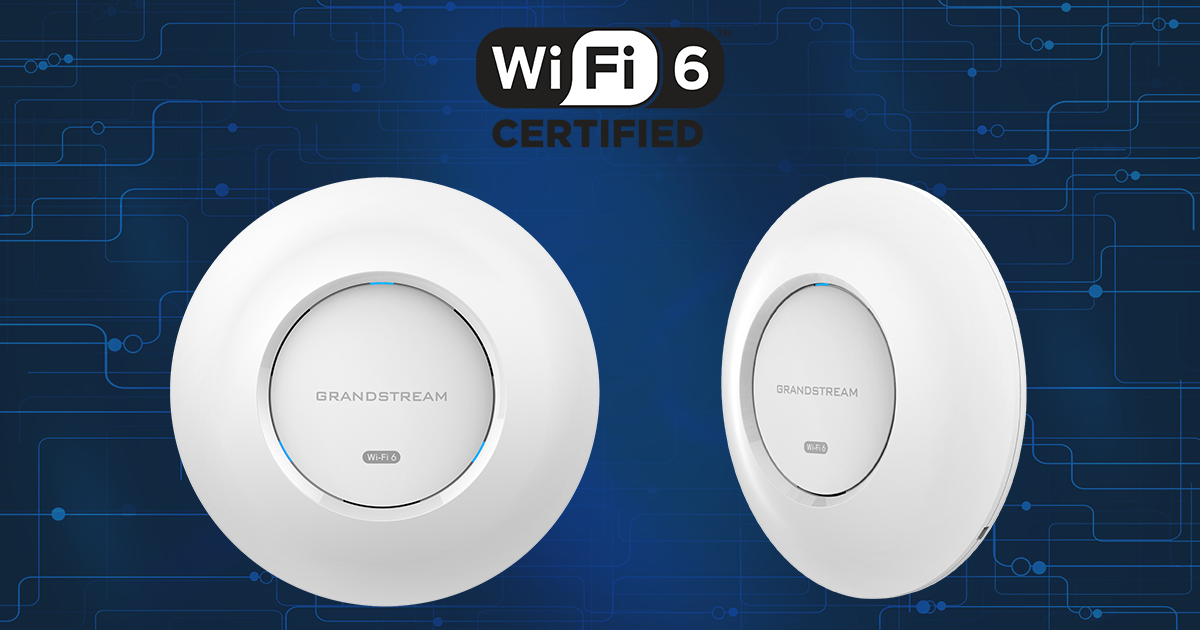
Most integrators treat Wi-Fi 6 access points as the value tier now that Wi-Fi 7 flagships own the spotlight. That is exactly why the Grandstream GWN7664E deserves a second look. It is the top of Grandstream’s dual-band Wi-Fi 6 indoor line: true 4×4:4 MU-MIMO on both radios, two 2.5G ports, and a client density number — 512 — that puts plenty of “enterprise” priced hardware to shame. And it does it on a single 802.3at PoE budget. After spec’ing these into real jobs, here is the honest installer read.
What the GWN7664E Actually Is
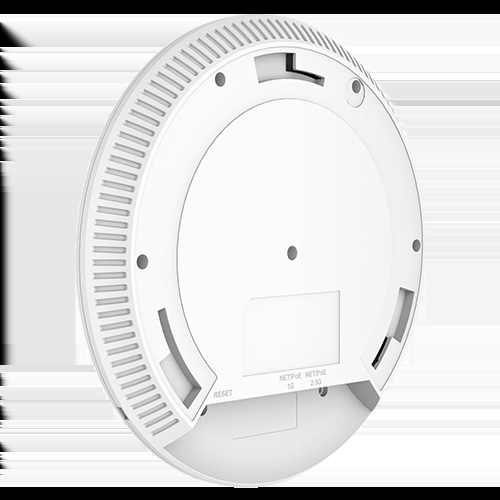
The GWN7664E is an indoor 802.11ax dual-band access point with eight internal antennas (four per band) and 2x 2.5G RJ45 ports. Grandstream rates it at 6 Gbps aggregate wireless throughput — 4804 Mbps on 5 GHz and 1147 Mbps on 2.4 GHz, both at full 4×4:4 MU-MIMO with DL/UL OFDMA. The wired side aggregates to 5 Gbps across the two multi-gig ports, which means you can trunk both ports into an mGig switch and actually feed the radio.
That last point matters more than the marketing numbers suggest. Plenty of Wi-Fi 6 APs advertise AX5400-class radios and then strangle them with a single 1G uplink. The GWN7664E is one of the cheaper ways to get a dual-2.5G AP on a managed network you already own the controller for — and Grandstream’s management stack (embedded controller, GDMS cloud, or GWN Manager on-prem) is free, per appliance, not per seat.
Verified Specifications
Everything in this table is straight from Grandstream’s official GWN7664E product page and technical specification sheet.
| Item | GWN7664E |
|---|---|
| Wi-Fi standard | IEEE 802.11a/b/g/n/ac/ax (Wi-Fi 6 CERTIFIED) |
| Radios / antennas | Dual-band, 4×4:4 MU-MIMO both bands, 8 internal antennas (2.4 GHz 3.5 dBi, 5 GHz 4.5 dBi) |
| Max data rates | 5 GHz: up to 4804 Mbps (ax); 2.4 GHz: up to 1147 Mbps (ax) |
| Channel bandwidth | 2.4 GHz: 20/40 MHz; 5 GHz: 20/40/80/160 MHz |
| Max TX power | 2.4 GHz: 26.5 dBm; 5 GHz: 25.5 dBm (region/MCS dependent) |
| Coverage / clients | Up to 175 m range; up to 512 concurrent clients |
| SSIDs | 32 total (16 per radio), captive portal and per-SSID bandwidth limits |
| Network ports | 2 x 2.5G Ethernet |
| Power | 802.3af/at PoE with auto-detection, max 21 W |
| Security | WPA/WPA2-PSK, WPA/WPA2-Enterprise (TKIP/AES), WPA3; anti-hacking secure boot, per-device certificate and random default password |
| Management | Embedded controller (up to 50 APs), GDMS Networking cloud (unlimited), GWN Manager on-prem (up to 3,000 APs) |
| Protocols / QoS | IPv4/IPv6, 802.1Q, 802.1p, 802.1x, 802.11e/WMM, beamforming |
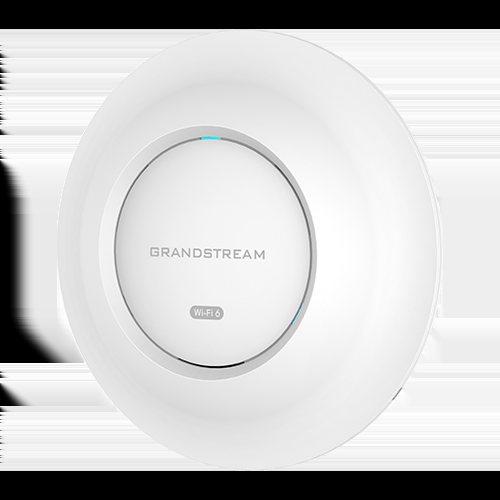
| Physical | 205.3 x 205.3 x 45.9 mm, 714 g; ceiling/wall mount kits included |
| Environment / compliance | 0–50 °C operating, 10–95% RH non-condensing; FCC, CE, RCM, IC |
How It Sits Against the Siblings
| GWN7664E (this post) | GWN7660E (little sibling) | |
|---|---|---|
| Radio config | 4×4:4 both bands | 2.4 GHz 2×2:2 + 5 GHz 3×3:2 |
| Aggregate wireless | 6 Gbps | 3 Gbps |
| Wired ports | 2 x 2.5G | 1 x 1G |
| Concurrent clients | 512 | 256 |
The story is simple: if your design has more than a dozen or so active clients per cell, or you want any headroom for dense OFDMA, the 4×4:4 radios and dual-2.5G uplink on the 64E are what you are paying for. If the room is small and dense-client counts are low, the 660E does the job for less money and a single gigabit uplink is fine.
Install Notes From the Field
A few things I check every time these go up. First, PoE budget: rated max is 21 W on 802.3at, so any decent PoE+ switch port covers it, and the AP auto-detects af versus at. If you are feeding it off a marginal af budget switch, verify the port negotiation before you button up the ceiling.
Second, those 2.5G ports are the reason to buy this AP — do not waste them into a gigabit switch port. Put it on an mGig access switch or at minimum a 2.5G port with 802.3bz negotiated; a link that falls back to 1G silently gives you a Wi-Fi 6 AP with Wi-Fi 5 plumbing.
Third, 160 MHz on 5 GHz is available, but on a multi-AP deployment I generally hold 80 MHz and lean on channel planning instead. The 160 MHz mode is great in a single-AP shop or a detached building, and it is where those headline throughput numbers live.
Fourth, ceiling mount, center of the coverage area, kits included in the box — the 4.5 dBi 5 GHz antennas want height and clear space, not a soffit corner.
Where This Fits Best
Dense small-to-mid business Wi-Fi. Offices, clinics, dealerships — anywhere 30–100 clients converge on one cell. 512-client capacity plus true 4×4:4 on both radios means the AP is never the bottleneck; the channel reuse plan is.
PoE-constrained retrofits. 21 W max draw means existing 802.3at infrastructure takes it without a switch upgrade, and the dual 2.5G ports future-proof the uplink even if today’s switch is gigabit.
Multi-floor residential and hospitality. The 175 m open-air range figure is marketing-flat, but through typical floor construction these cells throw a long way, and per-SSID bandwidth limiting plus the captive portal handle guest/homedevice segregation without a controller add-on license.
Cost-sensitive enterprise rollouts. Free management is the sleeper feature. Embedded controller covers sites under 50 APs with no cloud dependency at all; GDMS handles unlimited APs free; GWN Manager on-prem goes to 3,000. No per-seat subscription, ever.
Pros and Cons
Pros:
- Full 4×4:4 MU-MIMO on both bands — the real AX6000, not a cut-down radio
- Two 2.5G ports with link aggregation possible; wired aggregate 5 Gbps
- 512 concurrent clients and 32 SSIDs with per-SSID policies
- WPA3, secure boot, per-device certificates and random default passwords
- Free management at every scale (embedded 50, GDMS unlimited, on-prem 3,000)
- Mounting kits in the box; modest 21 W PoE budget
Cons:
- No 6 GHz radio — if you need Wi-Fi 7 or the 6 GHz band for backhaul or clean spectrum, step up to the GWN7672/GWN7674
- Indoor-only (0–50 °C); the ELR variants are the outdoor answer
- 160 MHz mode helps single-AP sites, but dense multi-AP designs still live at 80 MHz
- No PoE passthrough port for chaining a camera or two downstream of the AP
Bottom Line
The GWN7664E is the sweet spot of Grandstream’s Wi-Fi 6 indoor line: everything the smaller siblings trim back — spatial streams, uplink speed, client density — is restored here, and nothing you actually rely on day to day is missing. For dense SMB cells on existing PoE+ infrastructure, with free controller licensing and no subscription, it is one of the best cost-per-client APs you can spec today. Go Wi-Fi 7 at the edge only when you need 6 GHz; otherwise put the saved money into the mGig switch underneath it and call it a day.
Thinking about a GWN rollout, a mixed-vendor refresh, or a proper site survey? Get in touch and let’s talk through the design before the first mount goes up.
Specifications sourced from Grandstream’s official GWN7664E product page and technical specification documentation. Product imagery courtesy of Grandstream Networks.