
Grandstream WP820 Review: The Wi-Fi Phone That Made Me Stop Quoting DECT Base Stations
Most installer quotes treat the desk phone as the end of the VoIP job. Then the site walkthrough happens and somebody asks the question that kills half these deployments: “okay, but can I take a call in the warehouse?” The Grandstream WP820 is the phone Grandstream points at exactly that moment — a Wi-Fi handset that lives on your existing wireless network, roams between access points, and doesn’t require a single DECT base station in the ceiling. I’ve specified these on enough retail and light-industrial sites to have opinions, so here’s the honest breakdown of what the WP820 does well, where the Wi-Fi voice decisions start to bite, and which of its siblings you should have quoted instead.
What the WP820 actually is
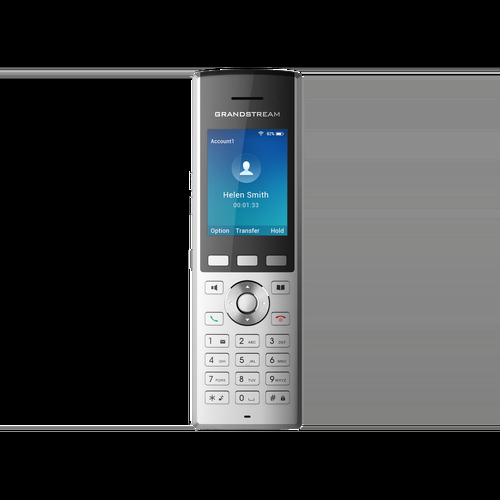
The WP820 is Grandstream’s mid-tier portable Wi-Fi phone — a handheld SIP endpoint that registers to your PBX over WPA2/WPA3-Enterprise Wi-Fi rather than DECT. Verified from Grandstream’s official product page and datasheet, the headline spec block reads:
- Wi-Fi: integrated dual-band 802.11 a/b/g/n (2.4 GHz and 5 GHz) with efficient antenna design and roaming support — 3 dBi peak antenna gain on both bands per Grandstream’s WP8xx roaming guide
- Lines: 2 SIP accounts, 2 lines
- Display: 2.4-inch 240×320 TFT color LCD with backlit keypad
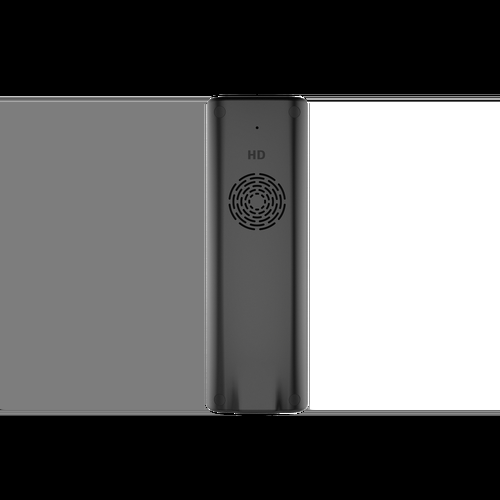
- Audio: HD voice, dual-mic design with AEC and Noise Shield Technology, HAC support, 3.5 mm headset jack
- Battery: rechargeable 1500 mAh Li-ion — 7.5 hours talk time, 150 hours standby
- Durability: drop-safe from 1.2 meters
- Extras: integrated Bluetooth, accelerometer plus configurable button for push-to-talk or panic functions, proximity sensor, vibration motor
- Codecs: G.711 μ/a, G.729A/B, G.722 wideband, iLBC, Opus
- Security: SRTP, TLS, 802.1x media access control, 256-bit AES encrypted configuration files
- Provisioning: TR-069, encrypted XML autoprov, TFTP/HTTP/HTTPS — and GDMS, Grandstream’s free central management platform
- OS quirk worth knowing: it runs Android 7.0 under the hood and supports custom Android apps sized to the screen — physical-key browsing only, no touchscreen
- Physical: 168.5 × 52.5 × 21.8 mm, 161 g; ships with charger cradle, belt clip, universal power adapter
How it sits against its siblings
Grandstream’s WP line spans the WP810 entry model up through the touchscreen WP856. The WP820 occupies the sensible middle, but two siblings nudge it in specific scenarios — figures below verified from Grandstream’s official product pages and WP series sales kit:
| WP810 | WP820 | WP825 | |
|---|---|---|---|
| Wi-Fi | 802.11 a/b/g/n/ac | 802.11 a/b/g/n | 802.11 a/b/g/n/ac |
| Display | 1.8″ 128×160 TFT | 2.4″ 240×320 TFT | 2.4″ 240×320 TFT |
| Battery / talk time | 1500 mAh / 6 h | 1500 mAh / 7.5 h | 2000 mAh / 8 h |
| Standby | 120 h | 150 h | 200 h |
| Bluetooth | — | Integrated | Integrated |
| Durability | Standard | Drop-safe 1.2 m | Ruggedized: waterproof, dustproof, drop-safe 2.5 m |
| SIP accounts | 2 | 2 | 2 |
Read plainly: the WP820 is the value pick when the building’s Wi-Fi is solid and the staff wearing these phones don’t need a rugged shell. If the handset is going on a forklift belt in a loading dock, the WP825’s rugged body and bigger battery are worth the delta. If nobody wears a headset on site, the WP810 saves money — but no Bluetooth means no wireless headset pairing, which on real sites means everyone ends up wearing a wire.
Where it earns its keep on real jobs
Retail floors that already have good Wi-Fi. This is the sweet spot. If the store runs a properly designed WPA2-Enterprise wireless network, the WP820 roams access points the same way the staff tablets do — no DECT base stations, no repeaters, no multi-cell controllers to commission. Grandstream’s own positioning is exactly this: call capacity limited by your Wi-Fi design, not by DECT’s handful of concurrent calls per base station.
Warehouses and back-of-house ops with push-to-talk needs. The accelerometer-driven configurable PTT/panic button is the feature that gets operations managers excited, and it earns its price on sites where supervisors need one-touch access to a dispatch bridge. Pair it with a wired headset on the 3.5 mm jack — or Bluetooth, since the WP820 has it on board.
Hoteling and shared-desk setups. Hot desking is supported natively, so a phone that walks off with a staff member can re-register cleanly to the shared extension. Provisioning at scale via TR-069 or GDMS means a batch of twenty handsets is an afternoon, not a week — Grandstream’s platform is free and covers firmware, config and monitoring in one pane.
Honest pros and cons
Pros:
- No DECT infrastructure — rides the existing Wi-Fi, one less system to buy, power and commission
- Real enterprise security stack: WPA-Enterprise, 802.1x, SRTP, TLS, encrypted config files
- 7.5 h talk / 150 h standby covers a full shift in normal use
- G.722 wideband and Opus codecs supported — future-proof audio on a modest handset
- Free GDMS management across the whole Grandstream estate — phones, APs, switches and PBX in one portal
- 1.2 m drop tolerance, belt clip and charger cradle in the box; built for hands, not desks
Cons:
- Wi-Fi 4 only — 802.11n on networks where every other client is Wi-Fi 6/7; it works, but you’re keeping legacy rates alive for it, and the WP822/WP825 siblings add ac
- 2.4-inch 240×320 screen with physical-key navigation — functional, not modern; no touchscreen until the WP856
- Two SIP accounts is fine for coverage lines, thin for a receptionist living on two queues
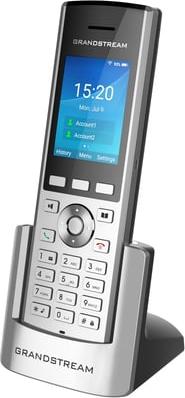
- The GMC08 eight-bay charger is a separate purchase — put it on the BOM before the fleet hits ten handsets
- Voice quality lives or dies by Wi-Fi design; a poorly designed warehouse RF plant makes every one of these phones sound worse than a DECT handset would
Installer notes before you quote it
Three things I’d bake into any WP820 estimate. First, audit the RF before promising coverage — voice over Wi-Fi wants sane roaming behavior, so make sure the AP side does 802.11r/k/v fast roaming properly and remember the phone prefers 5 GHz and falls back to 2.4 GHz on weak signal, per Grandstream’s WP8xx roaming guide; design so that behavior works in your favor rather than stranding handsets on the far AP. Second, standardize on WPA2/WPA3-Enterprise with 802.1x before a single handset is issued — per-handset PSK rotations are how these projects quietly die in month six. Third, plan charging: the single cradle is fine for two phones, but a fleet wants the GMC08 on the desk, and spare batteries per handset will save you the service calls.
Bottom line
The WP820 is the right phone when the wireless network is already an asset: retail floors, offices with walking staff, hotels with good RF, operations teams that want push-to-talk without buying a whole radio system. It is the wrong phone when the building’s Wi-Fi is an afterthought — or when the handset will live on a forklift belt in the rain, which is a WP825 conversation. For matched Wi-Fi and one-to-two-line mobile users, it’s one of the cleanest value picks in Grandstream’s catalog and it inherits the provisioning story that makes the rest of their lineup deployable at fleet scale. If you want help sizing a Wi-Fi voice fleet against your network — or weighing the WP820 against its rugged siblings — get in touch.
Product specifications and imagery sourced from the official Grandstream WP820 product page, datasheet and WP8xx roaming guide at grandstream.com. Product imagery courtesy of Grandstream Networks.