
Grandstream GSC3518HS: A Loud, Smart, Weatherproof Answer for Paging Big, Noisy Spaces
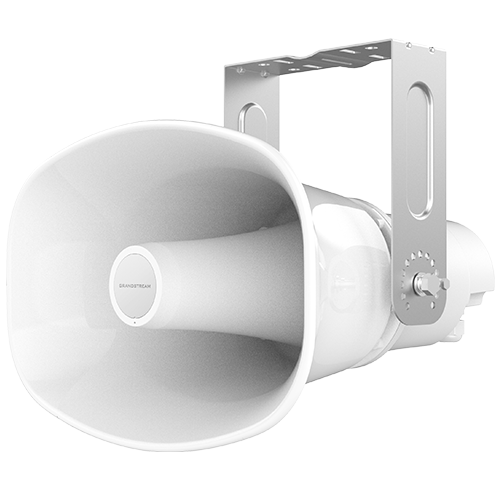
If you have ever tried to page a school playground, a loading dock, or an outdoor campus quad with a bargain bin PA system, you already know the problem: horn speakers are loud, but loud and intelligible are not the same thing. Grandstream’s GSC3518HS is the company’s answer for exactly this gap — a SIP and multicast talk-back horn speaker that pairs a genuinely powerful 50-watt driver with the networking, security, and management features you would expect from an enterprise VoIP vendor. It is one of those deceptively simple devices that ends up doing a lot of heavy lifting in a professional deployment.
What the GSC3518HS Actually Is
At its core, the GSC3518HS is a network-connected horn speaker that speaks SIP. It registers to any standards-based SIP platform — Grandstream’s UCM series and Wave UC platform included, but also third-party IP PBXs — and can receive pages, multicast announcements, and streamed audio, then answer back. Because it has three built-in microphones with an eight-meter (26-foot) pickup range, two-way talk-back works at distance, which is what makes it an intercom as much as a speaker. Someone can shout a question at the horn from across a yard and the person at the front desk actually hears them.
Add intelligent text-to-speech (type an announcement, have the horn read it), AI-based background noise reduction on the mic inputs, and full-band and wide-band codec support including Opus and G.722, and you have a paging endpoint that keeps announcements intelligible even when it is sitting next to running machinery.
The Spec Sheet Worth Knowing
Here are the numbers that matter when you are quoting a job:
- 50W high-fidelity driver with maximum output up to 126 dBA — seriously loud, and frequency response from 270 Hz to 13.2 kHz wide enough that speech stays crisp rather than turning into the classic horn-mumble
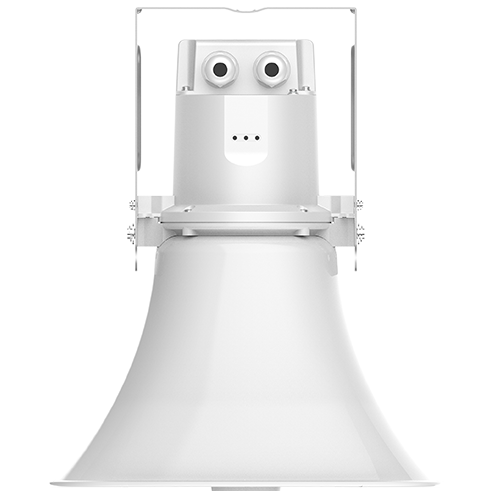
- PoE++ input (802.3bt Class 8, up to 71W) with PoE+ output (802.3at, up to 25W) — the pass-through port is the killer feature: one cable to the pole powers the horn and still has plenty left to daisy-chain a camera or an access point downstream, and Grandstream’s specs cover cascading multiple speakers this way
- Two 10/100 Mbps network ports (the PoE in / PoE out pair described above)
- Differential LINE IN and LINE OUT plus two switch-in inputs and a switch-out — so you can wire in existing amplifiers, emergency alert triggers, or an external mic zone, and tie in a door strike or relay
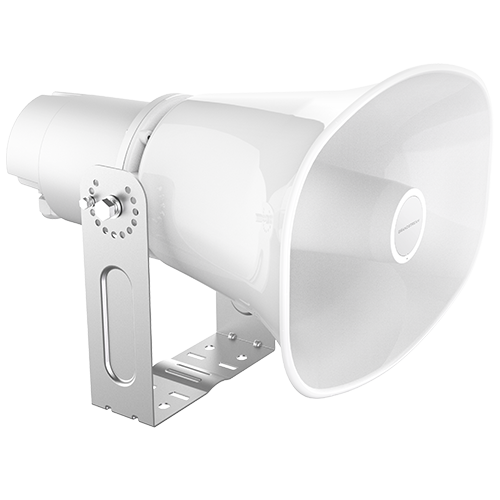
- IP66 weatherproofing — waterproof cable glands, PC + ABS housing with an aluminum back cover and stainless-steel mounting bracket, rated from -30°C to +60°C. This thing is built to live on the side of a building through a decade of weather
- Protocols: SIP RFC3261, RTP/RTCP with RTCP-XR, DHCP, DNS (A/SRV/NAPTR), LLDP-MED, TR-069, 802.1x, TLS, SRTP, IPv6, even OpenVPN for remote sites
- Paging methods: SIP paging, multicast paging, group paging, push-to-talk with call-waiting priority override — critical when an emergency page needs to cut through whatever was playing a moment before
- Modern inputs beyond SIP: AirPlay support, ONVIF streaming, RTSP/HTTP streams, local audio files, and mobile app playback (SecureAccess app management for the device is on its way)
- Provisioning: GDMS cloud, TR-069, or AES-256-encrypted XML config files, HTTPS and secure boot
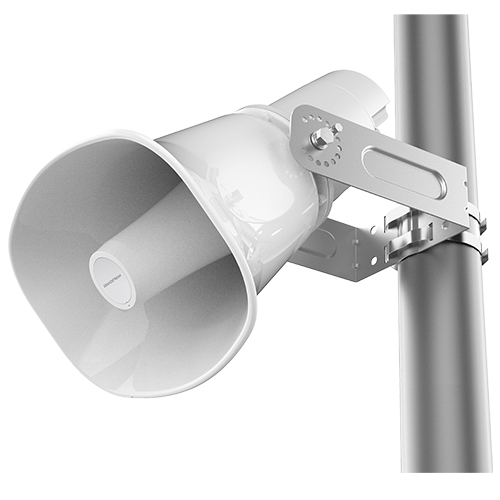
Physical size is roughly 325 x 285 x 204 mm at about 2.9 kg with the mounting kit — big enough to throw sound a long way, compact enough for wall or pole mounts on existing infrastructure.
Where I Would Deploy One (and Where Grandstream Pitches It)
The datasheet targets four environments, and every one of them matches what I have seen in the field:
1. Schools and educational institutions. Priority paging across playgrounds, gyms, and hallways is the classic case — a horn on the playground plus indoor ceiling speakers, all fed by the same multicast paging zones. The talk-back matters there too: when a teacher can reach the office from mid-playground (or the office can verify what a custodian is reporting before triggering an emergency response), you have a real intercom, not just a loudspeaker.
2. Industrial and factory floors. This is where the 126 dBA max output and the AI noise reduction earn their keep. On a noisy production line you need both the volume and the codecs — Opus and G.722 wide-band — so announcements cut through machinery without turning into mush. The differential line inputs let you integrate existing PA amplifiers rather than replacing the whole system during a phased upgrade.
3. Outdoor campuses, office parks, and mixed indoor/outdoor sites. Multi-floor, multi-zone paging with cascaded playback gives corporate announcements real reach. The PoE++ pass-through is the infrastructure win here — if your network drops to one outdoor pole anyway, feeding the horn and daisy-chaining the camera or AP downstream saves a second cable run, and PoE runs are dramatically cheaper than individual power drops plus the licensed electrician hours that come with them.
4. Public spaces and transportation. Parks, plazas, transit hubs, big-box retail perimeter — anywhere you need instant announcements with text-to-speech from a desk or a phone. Type the alert once, have it read verbatim across every zone. Combined with AirPlay and group paging, marketing or facilities teams can drive scheduled music or message playback without touching a phone system handset.
The Integrator’s View
What makes the GSC3518HS more than the sum of its parts is that it behaves like a managed network endpoint, not an audio orphan. It provisions through GDMS or TR-069 alongside the switches and cameras on the same network, it authenticates with real TLS/SRTP/802.1x security instead of a shared FTP password, and RTCP-XR gives you mean opinion score reporting, so a help desk can actually tell whether the horn heard the page or whether the network did not deliver it. Every dollar of a PA system is wasted if nobody trusts the announcements; every element of this design attacks exactly that problem.
The one thing I would flag before you quote it: confirm your PoE++ budget before planning big cascades. The horn itself can pass through up to 25W on the output port, which is a generous downstream feed, but each daisy-chained horn consumes from the upstream switch’s 802.3bt budget. Plan the chain lengths against your switch, not the datasheet’s theoretical maximum.
Bottom Line
The GSC3518HS is the rare PA component that a network integrator can install with confidence and a facilities manager can type into without a phone ever ringing. Loud where it counts, intelligible where it matters, PoE-driven, weatherproof, standards-based, and managed like everything else on your network. If you are building an intercom, paging, or emergency-alert system that has to cover big outdoor or noisy spaces — a school, a warehouse campus, an industrial site, or a public facility — this is at the top of my short list. And if you want help designing one — zoning, power budgets, multicast design, the whole picture — reach out and let’s talk.
Specifications sourced from the official Grandstream GSC3518HS datasheet. Product images courtesy of Grandstream Networks.