
Grandstream GRP2624 Review: The Carrier-Grade Desk Phone That Punches Far Above Its Price
If you have ever quoted an eight-line desk phone for a multi-tenant office and watched the per-seat number climb into the absurd, the Grandstream GRP2624 exists to make you smile. It sits in the middle of Grandstream’s GRP “carrier-grade” phone family, and it packs the features that used to justify the flagship tier: dual screens, Bluetooth, Wi-Fi, PoE, and provisioning at scale — for a price that lets you still make margin on a twelve-seat job.
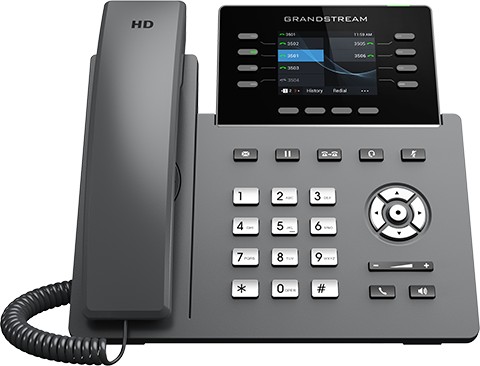
What the GRP2624 Actually Is
Grandstream describes the GRP series as phones “designed for mass deployment,” and the GRP2624 is the volume seller of that family in practice. Per Grandstream’s official product page, the headline specification list is:
- 8 lines, 12 SIP accounts — enough for an office manager covering three extensions
- GDMS cloud provisioning — centralized configuration, management, and monitoring
- Integrated Bluetooth — headsets, plus contact and calendar sync from your mobile
- Full-duplex HD speakerphone with noise shield technology to kill background noise
- Dual gigabit PoE ports — switched, auto-sensing 10/100/1000 Mbps
- 5-way audio conferencing built in
- Enterprise security — secure boot, dual firmware images, encrypted data storage
- Dual-band Wi-Fi (802.11 a/b/g/n/ac, 2.4 GHz and 5 GHz)
- Swappable faceplate for logo customization — useful on branded deployments
- GBX20 expansion module support — up to 40 contacts/BLF keys per module, up to four modules (160 total)
For comparison, the big brother GRP2670 buys you a 7-inch touchscreen and 16 SIP accounts; if the customer does not live on a reception desk, the 2624 covers the same job for a lot less per seat.
Where It Fits in the Real World
Multi-tenant office suites and professional buildings. This is the GRP2624’s home turf. Dual gigabit PoE means no switch port per phone if you daisy-chain, GDMS means the whole fleet provisions zero-touch from the cloud, and the swappable faceplate lets a property group drop their logo on every handset without a custom order.
Small law, medical, and accounting firms. Eight lines and 12 SIP accounts covers a partner who wants their personal line, the main line, and a coverage line all on one desk. The noise shield is not marketing fluff — in open-plan offices with HVAC roar, call quality is the thing clients actually notice.
Hotel and hospitality back-of-house. The GRP series is explicitly aimed at service providers and high-volume markets. Housekeeping and front desk phones that provision themselves overnight over GDMS are a real time-saver on 80-plus key jobs.
Cloud PBX: if your PBX is hosted (3CX, RingCentral, Zoom Phone, MS Teams via SIP gateway for phones, VitalPBX, FreePBX), the GRP2624 registers cleanly, including with firmware-level TLS/SRTP support built in.
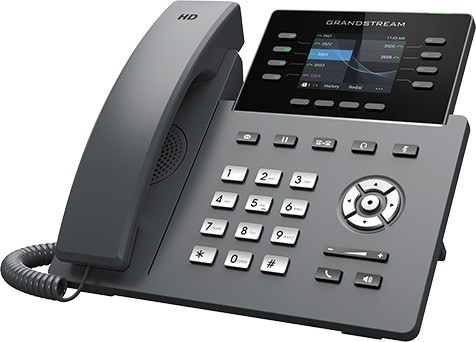
Pros
- Price-per-feature is the best in its class — you get Bluetooth, Wi-Fi, dual gig PoE, and enterprise boot security at a mid-tier price
- GDMS provisioning is genuinely zero-touch — ship the phone boxed to site, it calls home, it works
- Secure boot + dual firmware + encrypted storage — features that justify IT approval where a policy requires them
- Expandable to 160 BLF keys with four GBX20 modules if the receptionist ever promotes
- Open SIP — not wedded to any single hosted platform
Cons
- No color touchscreen — that is where the GRP2670 earns its premium; if the client wants a touch interface, sell up
- 8 lines/12 accounts is the ceiling — heavy reception desks will outgrow it
- Wi-Fi is Wi-Fi 5 (ac), not Wi-Fi 6 — the flagship GRP2670 has Wi-Fi 6; fine today, slightly dated for a 2026 buy
- GDMS is cloud-dependent if you want remote management; on-prem provisioning requires you to run your own auto-provisioning server
The Deployment Details That Matter on the Job
Provisioning path. Three options, and you pick based on who owns the relationship. GDMS cloud gives you zero-touch with no server to babysit — the phone boots, finds acms.grandstream.net, pulls its config, and reboots onto your VLAN. If the customer mandates on-prem, the phone speaks standard SIP with auto-provisioning over HTTPS to your own PBX, so FreePBX and VitalPBX templates work the same way the GXP ones always have. What you cannot do is run GDMS offline — if the circuit drops, existing calls keep working, but a freshly factory-reset phone will sit there until the internet does.
Power and cabling. Dual gigabit PoE means the phone chains off one switch port and hands the second port to the PC behind the chair. Plan for 802.3af class 3 budget headroom per drop — if you are cramming 48 phones on one switch, the PS budget is what fails, not the port count. Non-PoE sites: the phone takes a standard DC adapter, which means a power strip behind every desk. Multiply that by 30 desks and you know why PoE switches win this argument on every install.
Key modules and the upgrade ladder. The GBX20 snaps on with the included ribbon and cage, powered from the phone. Four modules take the phone to 160 BLF keys, which covers a busy dispatcher desk. But if that desk is live at 80+ BLFs on day one, price the GRP2670 or the expansion modules on day one — receptionists do not wait.
What It Costs and Who It Is For
Street pricing for the GRP2624 typically lands in the mid-range of Grandstream’s lineup — meaningful money below the flagship GRP2670, meaningful money above the entry GRP2614/2616 line. For installers the rule of thumb is simple: if the phone needs a touchscreen, it is a 2670 job. If the phone needs lines, BLF expansion, and provisioning scale, the 2624 does the job for less and no one at the desk knows the difference. The phones that get you laughed out of a reception area are the ones with 2 lines and no expansion — not this one.
For managed-service providers, the combination that pays is the 2624 plus GDMS tiering plus a standard template: one build per site type, fleet health visible from the dashboard, and a support story that does not require truck rolls for a reboot. That is the actual product Grandstream is selling here — the phone is just the sensor.
The Installer’s Bottom Line
The GRP2624 is the phone you quote when the job has 10–40 seats, someone needs 8 lines, and the budget spreadsheet is already crying. It gives the customer the features they can see on a spec sheet (Bluetooth, wireless, PoE, big BLF count) and gives you the features that actually pay the installer invoice: fast zero-touch provisioning, one VLAN config cloned across the fleet, and a phone that does not need a power drop. If the client walks in asking for a color touchscreen, step them up to the GRP2670 — but for everything else, the 2624 quietly runs the building.
Ready to spec a fleet upgrade for your business? Get in touch for a quote.
Product specifications and imagery sourced from Grandstream Networks’ official product pages (grandstream.com). Verify SKU availability with your distributor.