
Grandstream GWN7816P Review: A 48-Port Layer 3 PoE Switch That Earns Its Rack Space
Most switch line cards read like a spec sheet written by the marketing department. Grandstream’s GWN7816(P) is different in one important way: it is a genuine Layer 3 switch with dynamic routing at a price that makes you double-check the datasheet. If you run a medium-to-large site with a lot of PoE devices and you are tired of paying enterprise tax for features you could run yourself, this 48-porter deserves a spot on your shortlist.
I have spent time with Grandstream’s GWN line before, and the GWN7816(P) is where the family stops being “value option” and starts being a legitimate core-distribution candidate. Here is everything the official spec page confirms, what it means on a real job, and where the gaps are.
What the GWN7816(P) Actually Is
The naming convention trips people up: GWN7816 is the non-PoE model, GWN7816P is the PoE model, and Grandstream publishes them as one product page. Both are 48-port Layer 3 managed switches with six 10G SFP+ uplinks. The “P” adds powered ports with smart dynamic allocation. If your access layer feeds cameras, APs, or phones — and whose doesn’t anymore — you want the GWN7816P.
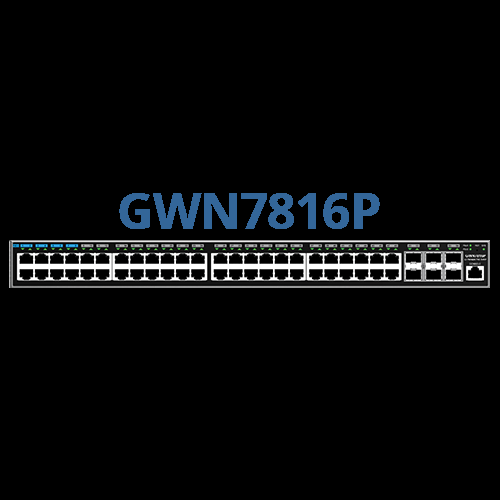
Verified Specifications
| Specification | GWN7816(P) |
|---|---|
| Gigabit Ethernet ports | 48 |
| 10G SFP+ uplink ports | 6 |
| PoE ports (P model) | 48, PoE/PoE+/PoE++ |
| Total PoE budget | 740W (60W PoE++ on ports 1–8, 30W on the rest) |
| Switching capacity | 216 Gbps |
| Non-blocking throughput | 108 Gbps |
| Forwarding rate | 160.704 Mpps |
| MAC address table | 32K (static, dynamic, filtering, sticky) |
| VLANs | 4K, 802.1Q, MAC-based, protocol-based, QinQ, private VLAN, voice VLAN |
| Routing | Layer 3: static (32 v4 / 32 v6), dynamic — RIP, RIPng, OSPF, OSPFv3, BGP |
| Routes | 12K IPv4 / 4K IPv6 |
| Spanning tree | STP/RSTP/MSTP/PVST+/RPVST+, 64 instances |
| Link aggregation | 32 |
| IGMP/MLD snooping | IGMPv2/v3 and MLDv1/v2 snooping, 256 groups, MVR |
| Security | 802.1X and MAC auth, RADIUS, TACACS+, DHCP snooping, ARP inspection, IP source guard, DoS protection, storm control, port isolation/security, loop/BPDU/root protection |
| Reliability | Fault detection, dual boot image, dual system file redundancy, link aggregation, storm control; stacking supported (listed “coming soon” by Grandstream); 1+1 redundant power with hot-swap RPS (CRPS-920W for the P model, RPS-70W for the non-P) |
| Management | Local web UI with embedded controller, CLI, GWN.Cloud, GWN Manager (on-prem, unlimited devices), free GDMS Networking |
The Install perspective
The PoE budget is the headline. 740 watts with 60W PoE++ on the first eight ports means you can hang high-power PTZ cameras, Wi-Fi 6/7 APs, and a door controller right off the ports most likely to need them, with 30W behind them for everything else. PoE devices are auto-discovered and powered on plug-in, which matters on a day when you are terminating forty drops and do not want to babysit power negotiation.
Layer 3 at the access layer changes your design. OSPF and BGP on an access switch means you can route between VLANs at the edge instead of hair-pinning traffic to a core box. On multi-building campuses or sites with redundant internet feeds, having BGP on the switch itself removes a whole layer of equipment from the bill. The 12K/4K route table is far more than any LAN will ever need.
Management is refreshingly open. Web UI, CLI, Grandstream’s free on-prem GWN Manager, or cloud GDMS — including free management of the whole Grandstream estate while you are there. The embedded controller manages GWN access points too, so a single-Great-value-shop deployment can run switches and Wi-Fi from one interface without a controller appliance.
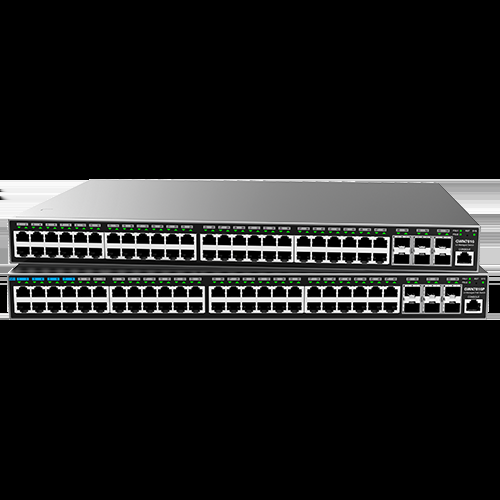
Where it fits in the field
installer note: this is the switch I reach for on mid-size commercial jobs where the customer wants one vendor for cameras, phones, Wi-Fi and switching. The PoE++ ports feed the PTZ domes at the gate, the 30W ports run the ceiling APs, the voice VLAN auto-detects every handset, and GDMS shows the whole tree from one login.
- Good fit: medium-to-large offices, campuses, distribution closets that need layer 3 without a separate router, all-Grandstream shops, anyone replacing an end-of-life managed switch who wants free management instead of a license renewal email every year.
- Bad fit: homes and micro offices (you will never touch 48 ports or a 740W budget), anyone who needs stacking today — Grandstream lists it as “coming soon” on this platform, so plan for independent management plus link aggregation until it ships — and datacenter builds expecting per-second per-port telemetry ecosystems from the big three.
Pros
- Real dynamic routing (OSPF, BGP) at an access-layer price
- 740W PoE budget with PoE++ on ports 1–8, auto-discovery
- Six 10G SFP+ uplinks, 216 Gbps switching capacity
- Full security toolkits: 802.1X, TACACS+, DHCP snooping, DA/IP guard
- Dual boot and dual system files, hot-swap RPS option for 1+1 power redundancy
- Free management: GDMS cloud, on-prem GWN Manager, embedded controller, CLI
Cons
- Stacking is announced “coming soon”, not shipping — mind your uplink redundancy plan until it lands
- VRRP, policy routing, GVRP and ERPS listed as pending features — verify against the current firmware release notes before designing around them
- 32 static routes per family is low if you truly route everything at the edge
- No 25G/40G uplink option; SFP+ tops out at 10G
How I would actually deploy one
On a typical single-switch build I put the uplink SFP+ ports to the router/firewall in an aggregate, carve a management VLAN with a single L3 interface, and let DHCP snooping plus dynamic ARP inspection guard every user-facing port group from the day one laptop decides to run its own router. Voice VLAN with OUI matching does the phone work for you: plug in a Grandstream handset and it lands on the voice network without a single port-config line. I lock the PoE++ ports 1–8 to PTZ and AP duty at the drop plan stage — future techs will plug a space heater into anything, but at least your cameras got first call on the watts.
For multi-switch sites, run 802.1ad QinQ between buildings if your uplinks need to carry more than one tenant’s VLANs, keep MSTP instances per customer, and turn storm control on globally with conservative thresholds. Once Grandstream ships stacking for this platform, the dual-chassis link-aggregation story gets cleaner, but nothing about today’s firmware stops you from building a redundant pair the classic way with two uplinks each and RPVST+.
Bottom line
The GWN7816P is what happens when a value brand quietly builds a real enterprise switch: dynamic routing, a serious security feature set, PoE++ where it counts, and management software that does not send an invoice. The stacking and a few routing features are still on the roadmap, so design today around link aggregation and a single uplink per VRRP plan, and upgrade when they ship. For a multi-vendor installer it is the easiest place I know to get L3 plus big PoE budgets without an enterprise support contract. If you want a network audit or a swap-out spec’d for your site, get in touch — we will tell you honestly whether you even need 48 ports.
Specifications sourced from Grandstream’s official GWN7816(P) product page (grandstream.com). Product renders courtesy of Grandstream Networks.