
Grandstream GWN7830 Series Review: The Layer 3 Aggregation Switch That Undercuts the Enterprise Brands
Most installer networks don’t fail at the edge. They fail at the aggregation layer — the spot where a dozen access switches, a surveillance VLAN, and a NAS all funnel into the core, and someone spec’d a box that was never meant to route between them. Grandstream’s GWN7830 series — the GWN7830, GWN7831, and GWN7832 — is the company’s answer for that layer: full Layer 3 management, SFP-first port counts, stacking, and the same free GDMS cloud management the rest of the GWN line uses. Here’s the full verified picture from Grandstream’s official datasheet.
The Series at a Glance
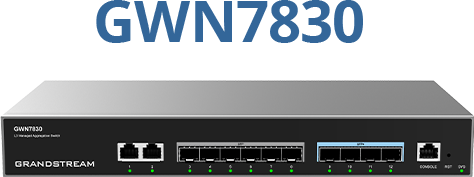
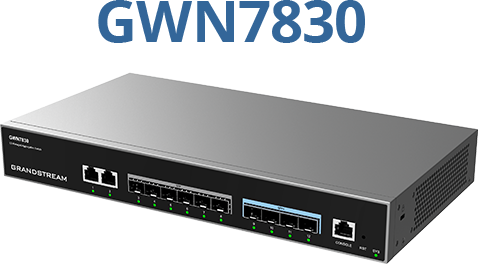
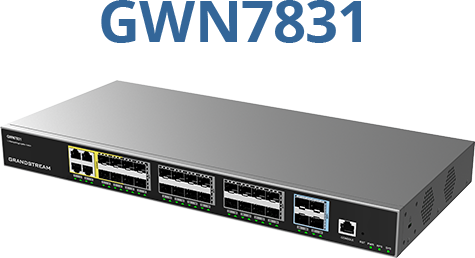
The GWN7830 series is three switches built on one firmware family. Every model runs full Layer 3 — dynamic routing, not the “L3 lite” static-pretending stuff you see on cheaper aggregation boxes. Where they differ is port density, throughput, and power redundancy:
| Spec | GWN7830 | GWN7831 | GWN7832 |
|---|---|---|---|
| Gigabit Ethernet ports | 2 | 4x combo | — |
| 1G SFP ports | 6 | 24 | — |
| 10G SFP+ ports | 4 | 4 | 12 |
| Total non-blocking throughput | 48Gbps | 64Gbps | 120Gbps |
| Switching capability | 96Gbps | 128Gbps | 240Gbps |
| Forwarding rate | 71.424Mpps | 95.232Mpps | 178.56Mpps |
| Packet buffer | 12Mb | 12Mb | 16Mb |
| Network latency | <4µs | <4µs | <2µs |
| MAC table | 16K | 16K | 32K |
| Integrated power supply | 30W | 60W | 60W |
| External redundant power (RPS) | Not supported | 12V/60W (RPS-60W-B) | 12V/60W (RPS-60W-B) |
| Standalone routing table | 512 IPv4 / 128 IPv6 routes | 12K IPv4 / 4K IPv6 routes (top-spec column) | |
Installer note on the table: Grandstream’s datasheet prints the L3/L2 feature set across the series — the 32K MAC table, 64 spanning-tree instances, and the big route table land in the top-spec column, so if you need the full table on a single switch, that’s the GWN7832. All models do support dynamic routing including RIP, RIPng, OSPF, OSPFv3, and BGP.
What the Series Actually Does Well
Optics-first design. The GWN7832 is 12x 10G SFP+ with nothing but SFP on the front — a pure fiber aggregation block. The datasheet confirms DAC cable support up to 5m, and RJ45 SFP modules are supported in specified quantities per model (the 1G RJ45 modules must be interval-inserted on the higher-density models). If your building runs fiber to each floor’s closet and you want one clean box where all the uplinks land, this is the shape you want.
Real Layer 3 features. OSPFv3 and BGP on a switch this price is unusual at this tier. Add VRRP (marked pending on the datasheet, worth confirming on your firmware build before you design around it), ERPS (also pending), 32 link aggregation groups, and spanning tree from STP through RPVST+. For a multi-VoIP-VLAN site doing inter-VLAN routing at the core, this eliminates a router hop.
Security that a managed core should have. Dynamic ARP Inspection, IP Source Guard, DHCP/DHCPv6 snooping, 802.1X and MAC authentication with RADIUS/TACACS+ and AAA, storm control, port security with sticky MAC, DoS defense (Land, Smurf, TCP SYN, ping flooding), and up to 4K ACLs on Ethernet/IPv4/IPv6 (2K on the GWN7830). On shared-tenant buildings this is exactly the tool set you want at the aggregation point.
Reliability plumbing. 6KV surge protection on power (per the datasheet), dual boot from two FLASH chips, dual system-file redundancy, fan fault detection with temperature-based speed control, and dual-PSU capability on the 7831/7832 via Grandstream’s optional RPS-60W-B. Stacking supports virtualizing up to four switches into one management domain with cross-device link aggregation for redundancy.
Management without a license bill. Web GUI, CLI over console/Telnet/SSH, SNMP v1/v2c/v3, RMON, LLDP/LLDP-MED, sFlow (pending), plus GDMS Networking (free cloud) and GWN Manager on-prem. If you already run GWN access points or routers, the core switch shows up in the same pane with zero extra cost, and the GWN7830 series also embeds a controller for other GWN switches.
Honest Downsides
- No PoE anywhere in the series. These are pure switching blocks — powered ports live on your access switches. Fine at aggregation, wrong at the edge.
- The GWN7830 has no RPS support, so single-PSU is all you get on the little one. If redundancy matters, buy up.
- Several marquee features — BGP policy routing, VRRP, ERPS, GVRP, sFlow, TR-069 — are marked (pending) on the datasheet. Core dynamic routing works; pin down exact firmware support before committing a design to a pending feature.
- Grandstream’s aesthetic is utilitarian; in a client-facing MDF where looks matter, some clients side-eye the badge regardless of specs.
Where These Fit on Real Jobs
The mid-size campus core. Put a GWN7832 in the main rack, fiber uplinks to two or three floor switches, OSPF or statics between them, and stack if you grow. The 12 SFP+ ports and 240Gbps backplane give you headroom most 24-port “aggregation” switches can’t touch.
Multi-tenant MDU or commercial building. GWN7831 in the basement: 24 GbE SFP ports feed fiber drops to each suite riser, DAI plus port security keeps one tenant’s misbehaving gear from poisoning DHCP for everyone, and 802.1X/RADIUS ties into your existing auth if you run it.
Surveillance aggregation. IGMPv2/v3 and MLD snooping with 256 groups per model plus auto voice VLAN and LLDP-MED mean cameras, intercoms, and paging sit cleanly on their own VLANs with multicast handled at the switch instead of flooding every closet. Pair with a GWN series router or a UniFi gateway and you have a mixed-vendor core that behaves.
Budget-friendly core upgrade. The GWN7830 as the entry point: small office, four SFP+ uplinks, a couple of copper ports for the firewall and management, OSPF if the upstream wants it. No redundant power, so put it on a clean UPS like everything else in the rack.
Management and Day-2 Operations
Day-2 is where Grandstream quietly wins installs. Every GWN switch ships with an embedded controller in its own web UI, so a single-switch site needs no appliance at all; grow to five or fifty sites and GDMS Networking is free cloud management with firmware pushes, config backups, and remote troubleshooting — no per-device license line item to renegotiate with the client every year. GWN Manager covers the on-prem crowd who want control inside their own walls, and the GWN7830 series can also be managed through a GWN series router on small-site builds. On the switch itself you get CPU and memory monitoring, power supply and fan fault alarms, SPAN/RSPAN mirroring, copper testing, Syslog, and upgrade over FTPS/TFTP/HTTP/HTTPS or mass provisioning via DHCP option. None of it is flashy. All of it is what actually saves you a truck roll at 7pm.
Power and installation notes. The GWN7830 ships with desktop, wall-mount, or rack-mount options and includes rack-mounting kits, with a 1.2m 10A power cord and grounding cable in the box. The 7831 and 7832 run 60W internal supplies with the optional RPS-60W-B for seamless failover — Grandstream rates that module at 60W max output. Thermal envelope is 0 to 45 degrees C operating, which matters more than people think in un-air-conditioned riser closets; check your closet temps before you commit the core switch to it.
Bottom Line
The GWN7830 series is the strongest value play in Grandstream’s networking line for integrators who need a genuinely Layer 3 core — dynamic routing, real security features, stacking, and free cloud management — without paying enterprise-brand money. Pick the GWN7832 for any real aggregation layer, the GWN7831 when you need a lot of 1G fiber ports with redundant power, and treat the GWN7830 as the small-site entry. Verify anything the datasheet marks “pending” against the current firmware before you design it into a build that has to deliver on day one. If you want help speccing a core layer around this series, reach out.
Product imagery and specifications courtesy of Grandstream Networks’ official product page and GWN7830 Series datasheet.