
Grandstream GWN7672 Review: The Wi-Fi 7 AP With Two 5G Ports That Fits the Mid-Market Budget
Why Wi-Fi 7 Matters for Installer Integrators Right Now
Two years ago Wi-Fi 7 was a roadmap slide. Now it is a line item on real quotes, and the mid-tier of the market has quietly gotten very good. The Grandstream GWN7672 is the clearest example of that shift: a tri-band, Wi-Fi CERTIFIED 7 access point with a 10G-class wired side at a price point that would have bought you a Wi-Fi 6 single-radio box not long ago. For installer-integrator shops that live in the space between enterprise pricing and prosumer reliability, this is the AP to beat in its class right now.
I spent time with the official specifications, and this is what stands out: Grandstream is not selling you a flagship spec sheet with a flagship price. The GWN7672 delivers the parts of Wi-Fi 7 that actually show up in day-to-day operation — MLO, wider channels, preamble puncturing, real client density — while keeping the price and power envelope of a normal ceiling AP. Let’s walk through it.
Verified Specifications (Grandstream Official)
| Specification | Grandstream GWN7672 |
|---|---|
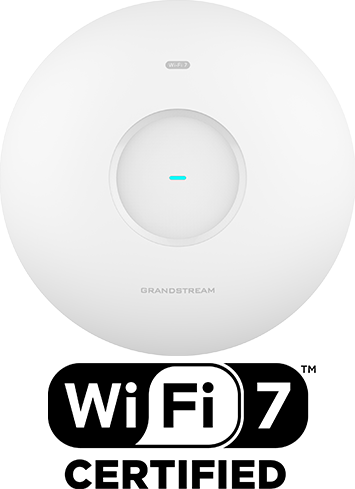
| Wi-Fi standard | Wi-Fi CERTIFIED 7 (IEEE 802.11a/b/g/n/ac/ax/be) |
| Radios | Tri-band: 2.4 GHz + 5 GHz + 6 GHz, 2×2:2 MIMO each |
| Aggregate wireless throughput | Up to 11 Gbps (BE11000): 688 Mbps on 2.4 GHz, 4320 Mbps on 5 GHz, 5765 Mbps on 6 GHz |
| Aggregate wired throughput | 10 Gbps |
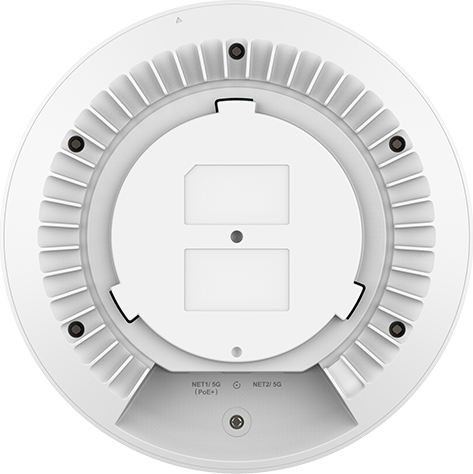
| Network interfaces | 2x 5G Ethernet WAN/LAN ports |
| Key radios tech | MLO (Multi-Link Operation), 4K QAM, MRU, preamble puncturing |
| Client capacity | Up to 384 concurrent clients |
| Coverage | Up to 175 meters |
| Antennas | 7 single-frequency antennas |
| SSIDs | 48 total, 16 per radio |
| Security | WPA3, WPA/WPA2 Enterprise (TKIP/AES), WEP (legacy); anti-hacking secure boot, digital signature lockdown, unique certificate and random default password per device |
| PoE | 802.3at PoE+ with auto-detect self-power adaptation; max draw 25 W |
| Management | Embedded controller (up to 50 local APs), GDMS Networking cloud (unlimited), GWN Manager on-prem, GDMS mobile app |
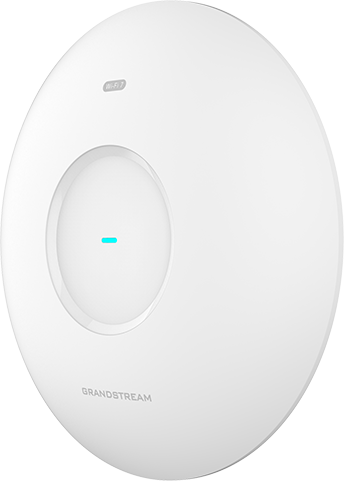
| Dimensions / mount | 220 x 220 x 54 mm; ceiling or wall mount, kits included |
What Actually Matters in This Spec Sheet
The dual 5G ports are the headline feature for integrators. Most APs at this tier give you one 2.5G uplink. The GWN7672 gives you two 5G ports, for 10 Gbps aggregate wired throughput. In practice that means you can daisy-chain multi-gig drops or run a link-aggregated uplink without stepping up to a flagship AP or a switch port that costs more than the radio. If your client’s laptops and desktops are already Wi-Fi 7-capable — and by 2026 most of the premium fleet is — a 2.5G uplink is the bottleneck, not the airtime.
Tri-band with true 2×2 MIMO on all three radios. Some tri-band designs fake it with a shared radio chain; Grandstream runs dedicated 2×2:2 on 2.4, 5, and 6 GHz. Combined with MLO, which lets a capable client use multiple bands simultaneously, you get both throughput and resilience. When the 6 GHz band congests or a radar events kicks you off DFS channels, MLO keeps sessions alive on the other links instead of dropping the call.
384 clients per AP is real density headroom. That’s the number that lets you quote a 200-seat office with confidence, or a gymnasium, or a warehouse with a big scanner fleet. Most small-business APs quote inflated client numbers that collapse under real traffic; Grandstream’s GWN line has a decent track record in the field with VoWiFi handsets, which is the hardest traffic you can put on Wi-Fi.
Free management, three ways. GDMS cloud is free with no per-device licensing — a genuine differentiator against every subscription-based cloud controller in the business. The embedded controller handles up to 50 APs locally with no cloud dependency at all, and GWN Manager gives you an on-prem option for the shops that refuse cloud on principle. For an installer, no license fees means no churn risk when the client’s budget gets squeezed.
Install Use Cases
Medium-to-large offices upgrading to Wi-Fi 7. This is exactly the market Grandstream built the 7672 for: medium-to-high user density, real client counts, and clients demanding multi-gig wireless. Ceiling-mount density planning stays the same as any good 2×2 design; you just stop undersizing the uplink.
VoWiFi-heavy sites. Grandstream makes the phones, the APs, and the PBX, and the QoS is written with VoWiFi handsets in mind. If you’re deploying GWP6230-class handsets or GRP Wi-Fi models, running the whole stack on GWN with MLO is the cleanest path to acceptable latency. It’s a self-reinforcing ecosystem sell.
Retail and education with mixed legacy clients. The 2.4 GHz band stays alive for old scanners, badge readers, and HVAC controllers while your premium clients ride 6 GHz. 48 SSIDs gives you room for staff, guest, BYOD, IoT, and POS VLANs with spare IDs — that’s genuinely generous at this price.
Installer note on power: the AP self-adapts when it detects plain 802.3at PoE+ rather than the higher budgets. On a mixed switch where you’re trying to cram every port full, verify per-port budget before you trust the aggregate number, and run Cat6A to the AP even though it will happily talk on lesser cable — future you will be grateful.
Pros and Cons
Pros:
- Dual 5G (10G aggregate) wired ports at a mid-tier price — rare in this class
- Genuine tri-band Wi-Fi 7 with MLO, 4K QAM, MRU, and preamble puncturing
- 384-client density and 175 m coverage claims that match real deployment behavior
- Free management: cloud (GDMS), on-prem (GWN Manager), embedded (50 APs), and mobile app
- Secure boot, unique per-device certificate and random default password out of the box
- Mounting kits included; conservative 25 W power draw on PoE+
Cons:
- 6 GHz performance depends on clean local spectrum — do your site survey before promising 5765 Mbps to anyone
- Ecosystem management is Grandstream-only; multi-vendor shops may prefer controller-neutral platforms
- 2×2:2 radios are honest but not flagship — 4×4 tri-band models exist if the quote allows
- MLO benefits only appear when clients are also Wi-Fi 7 — plan the client fleet refresh window
Bottom Line
The Grandstream GWN7672 is the Wi-Fi 7 AP I’d put on a quote when the client wants the new standard without the enterprise tax: dual 5G uplinks, three real radios, 384-client capacity, and free management with no per-seat subscription. It’s not the biggest radio Grandstream makes, and it doesn’t need to be — it’s the price/performance knife-cutter of the GWN Wi-Fi 7 line, and for installer-integrator work it hits the sweet spot between what the client wants to pay and what the network actually needs. If your shop already runs GWN switches or Grandstream phones, the ecosystem bonus makes it an easy default. Run the survey, respect the 6 GHz planning rules, and put two of these on every 200-seat floor and you will not get a callback.
Want a Wi-Fi 7 design or quote for your site? Get in touch and we’ll spec it against your actual client fleet and switch budget.
Specifications and product imagery courtesy of Grandstream Networks (grandstream.com official product page). Images cropped from vendor renders; no specs from third-party sources.