
Grandstream GCC6020 Series Review: The All-in-One Box That Replaces Your Gateway, Firewall, and PBX
Every integrator has done this job: a 40-seat office that needs a decent gateway, a real firewall, a phone system, and PoE for a handful of APs and desk phones, on a budget that does not stretch to four separate boxes plus a support contract for each. The usual answer is a UDM Pro and a hosted PBX subscription, or a firewall plus an on-prem PBX VM plus a UPS to keep all three alive. Grandstream’s answer is the GCC6020 Series — literally one box that is a VPN router, a next-generation firewall, an IP PBX, and a network switch at the same time. That is either very clever or a recipe for one support ticket taking down your phones and your internet together. Here is what the datasheet actually says and where this thing earns its rack space.
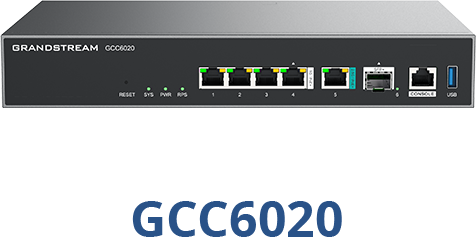
The Two Models, Side by Side
Grandstream builds the series in two sizes. Both run the same quad-core CORTEX-A73 at 1.8 GHz and the same feature set — the difference is raw throughput and port count, which is exactly how you’d want a product line like this split.
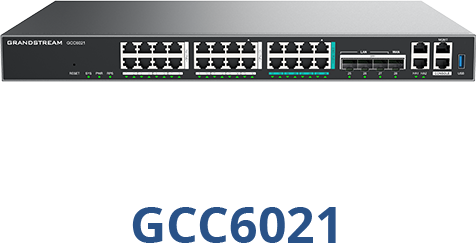
| Spec | GCC6020 | GCC6021 |
|---|---|---|
| CPU | Quad-core CORTEX-A73, 1.8 GHz | Quad-core CORTEX-A73, 1.8 GHz |
| Network ports | 1x 10G SFP+, 1x 2.5G, 4x GbE (up to 3 WAN-configurable) | 4x 10G SFP+, 8x 2.5G, 16x GbE (up to 5 WAN-configurable) |
| PoE | 5 ports PoE out (802.3af/at), 120 W budget | 8 ports PoE++ (af/at/bt) + 16 ports af/at, 370 W budget |
| Routing throughput | 6.5 Gbps | 10 Gbps |
| NGFW throughput (DPI + IPS) | 6 Gbps | 9 Gbps |
| IPsec VPN throughput | 1.3 Gbps | 1.3 Gbps |
| NAT sessions | 1M | 1M |
| PBX capacity | 50 users / 16 concurrent calls default (paid upgrades) | 50 users / 16 concurrent calls default (paid upgrades) |
| Wi-Fi controller | Up to 300 GWN APs / 500 clients | Up to 300 GWN APs / 1,000 clients |
| HA | Hot standby support | Hot standby, 2x dedicated HA ports |
| Aux ports | Console, USB 3.0 | Console, USB 3.0, 2x HA, MGMT |
| Memory | 4 GB RAM, 4 MB NOR + 32 GB eMMC | 4 GB DDR4 + 256 MB DDR3, 4 MB NOR + 32 GB eMMC, 8 MB NOR + 128 MB NAND |
| Power | 54 VDC / 2.8 A (150 W) adapter, RPS input | 54 VDC / 7.8 A (420 W) adapter, RPS input |
| Mounting / size | Desktop, wall mount, rack mount — 280 x 185.5 x 44 mm, 1.5 kg | Desktop, wall mount — 440 x 301.5 x 44 mm, 4.2 kg, metal case |
| Storage | Optional M.2 SSD | — |
What The Firewall Half Actually Does
This is the part that separates the GCC from a router with a PBX bolted on. Grandstream puts a VB100 Grade-A anti-malware engine on the box, plus real Layer 3-7 security: signature-based IDS/IPS with auto rule updates on a configurable cron, real-time SSL deep inspection with block and allow lists, DPI with application identification and control, Geo-IP filtering, DNS filtering with URL/category/keyword control, and email security. On top of the usual stateful inspection, DoS protections (UDP/ICMP/SYN flood), spoofing defense, port forwarding, DMZ, and UPnP. The DPI and IPS engine runs on Grandstream’s cloud firewall subscription plans — factor that into the TCO conversation with the client, and note it as a running cost rather than a one-time buy.
VPN coverage is current-gen and then some: WireGuard, OpenVPN client and server, IPsec site-to-site and client-to-site (3DES/AES, SHA-2-256, DH groups up to 14, NAT traversal), plus legacy PPTP and L2TP for the client that will absolutely still demand them. Both models handle multiple WAN connections with load balancing and failover, dynamic routing, and built-in DHCP and DNS servers, an IGMP proxy, and a TURN server — the last one being a quiet win for any site running WebRTC phones or video conferencing across NAT.
What The PBX Half Actually Does
Out of the box you get 50 users and 16 concurrent calls with paid capacity upgrades above that — enough for most single-site SMB jobs without touching a license spreadsheet. Full PBX services: call forwarding, transfer, parking, intercom/paging, IVR, emergency calls. Built-in audio and video conferencing with Wave clients for desktop, web, Android, and iOS. Codec support reads like a Grandstream spec sheet should: Opus, G.711 a/u-law, G.722/G.722.1/G.722.1C, G.729A/B, iLBC, GSM, T.38 fax, and H.264/H.263/H.263+/VP8 video, with FEC, jitter buffering, and NetEQ for audio resilience. Provisioning for Grandstream SIP endpoints is fast, there’s a full API for third-party integration, and it hooks into PMS, call center, and CRM systems — so hotel and medical deployments are realistic targets, not stretch goals.
Install Notes From The Field Perspective
The convergence pitch only pays off if management is genuinely one pane. It mostly is: GDMS, the free Grandstream Device Management System, handles provisioning, firmware, monitoring, alarms, and statistics for the GCC plus every GWN AP, switch, and endpoint on the account, individually or in batches by site, group, or model, with a visual topology graph and two-factor login. SSH, SNMP v1/v2c/v3, CLI, and a local web UI cover the folks who don’t want cloud dependency on the box that runs both their phones and their uplink.
Where I’d caution buyers: single-box convergence means a single failure domain. Grandstream’s answer is hot-standby HA — and on the GCC6021 that’s two dedicated HA ports plus a redundant power input, which is exactly what you want when the PBX and the firewall share a chassis. On the small GCC6020 you’re carrying the whole egg basket in a 1.5 kg desktop box with a single 150 W brick; fine for a small office, but spec the HA pair or a separate gateway if the client can’t afford both phones and internet down at the same time.
One more detail installers will care about: the GCC switch layer supports dynamic PoE power allocation per port (PoE++ on the 6021), 802.1Q/p/x, and QoS with VoIP prioritization and per-class policing. Because the PBX shares the box with the switch, voice traffic never traverses an external uplink — the latency and jitter improvement is real, which is the honest technical argument for convergence beyond “one less box on the shelf.”
Pros
- Genuinely four functions in one chassis without feature dilution — the NGFW and PBX are full products, not router-lite approximations
- VB100 Grade-A anti-malware, real IDS/IPS with scheduled rule updates, SSL deep inspection
- WireGuard on an SMB gatekeeper box in this class is still unusual and welcome
- 370 W PoE++ budget and four SFP+ on the 6021 cover a whole site’s APs and phones
- Hot-standby HA with dedicated ports, redundant power input
- Free GDMS cloud management across APs, switches, and endpoints; 3-year warranty guaranteed
- Built-in TURN server — WebRTC phones work cleanly through NAT
Cons
- PBX capacity caps at 50 users / 16 concurrent calls by default — bigger jobs need paid upgrade licenses
- The advanced firewall engine leans on Grandstream’s cloud subscription plans
- Single failure domain when router, firewall, and PBX share one box — HA pair recommended for anything business-critical
- The built-in Wi-Fi controller manages GWN access points; an existing non-Grandstream AP fleet stays a second management plane
- The compact 6020’s single 150 W adapter offers no path to power redundancy
- Rack-mount is listed for the 6020; the metal 6021 is desktop/wall mount only — plan the shelf
Bottom Line
The GCC6020 Series is built for exactly one job and it does that job well: the single-site SMB that wants one box, one management plane, and one vendor to point at. For a 30-50 seat office with a handful of GWN APs and Grandstream phones, the GCC6021 deletes a gateway, a firewall box, a PBX appliance, and an access switch from the quote — and the integrated QoS path from handset to Wi-Fi is a measurable win, not marketing. If the client already has a non-Grandstream AP fleet or needs beyond fifty seats without licenses, the convergence discount evaporates and separate boxes will manage better. Pick the 6021 when PoE budget and SFP+ count matter and you can shelf it; pick the 6020 when it has to live in the rack and the site is small enough that one power brick is an acceptable risk. Either way, put an HA plan on the quote before the first outage conversation.
Need help speccing a converged gateway-PBX for a client site? Get in touch — I’ll size it honestly.
Product specifications from Grandstream’s official GCC6020 Series product page and datasheet (8.2026 v3). Product imagery courtesy of Grandstream Networks.