
TP-Link EAP772 Review: The Wi-Fi 7 AP Where the Radio Is the Same and the Port Is the Choice
Most installers already know the EAP773. It was one of the first Wi-Fi 7 access points on the Omada line with a 10G uplink, and it has had a full review here on this blog. But its sibling, the TP-Link Omada 7 Pro EAP772, is the unit I actually specify when a customer wants Wi-Fi 7 radio performance and their access switch layer is 2.5G anyway. The MSRP on TP-Link’s own Omada lineup comparison is $169.99, against $189.99 for the 10G model. Same radio headline, same coverage class, same client target. The difference is one port.
Everything below comes from TP-Link’s official EAP772 product and specification pages, plus the Omada Wi-Fi 7 lineup comparison. No forum math and no reseller guesses.
The short version
The EAP772 is a tri-band, six-stream BE11000 ceiling-mount access point: 5765 Mbps on 6 GHz, 4324 Mbps on 5 GHz, and 688 Mbps on 2.4 GHz, with a single 2.5GbE uplink and 802.3at PoE+ power. It runs the full Wi-Fi 7 feature set TP-Link advertises for the line — MLO, 320 MHz channels, 4K-QAM, Multi-RUs, OFDMA, MU-MIMO, BSS Coloring — and it is covered for 380-plus concurrent clients across up to 1,500 square feet.
Here is the part that decides the purchase. The EAP772’s wired side is one 2.5G port. The EAP773 next to it on the same spec page has a 10G port, at twenty dollars more. If your access switch ports are 10G, the 2.5G radio uplink on this AP is the pipe you are living with. If your access layer is 2.5G — which it is on most mid-size commercial jobs I wire — the radio and the port match perfectly and the extra twenty buys you nothing.
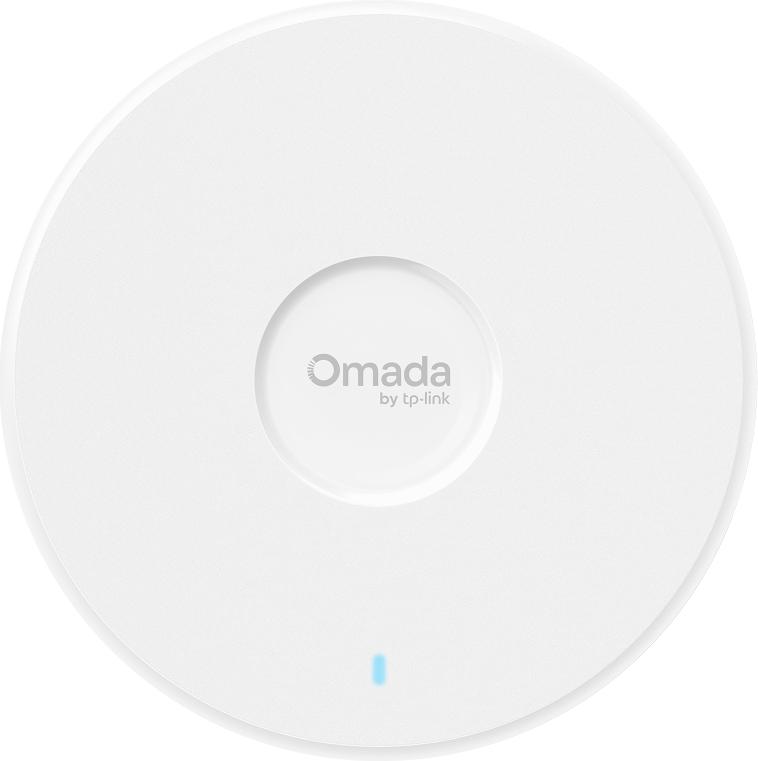
Verified specifications
| Wi-Fi standard | Wi-Fi 7 (802.11be), plus a/b/g/n/ac/ax |
| Bands and streams | Tri-band, 6-stream total (2×2 per band) |
| Max signal rates | 5765 Mbps (6 GHz) + 4324 Mbps (5 GHz) + 688 Mbps (2.4 GHz) |
| Wi-Fi 7 features | MLO, 320 MHz bandwidth (6 GHz), 4K-QAM, Multi-RUs, OFDMA, MU-MIMO, BSS Coloring |
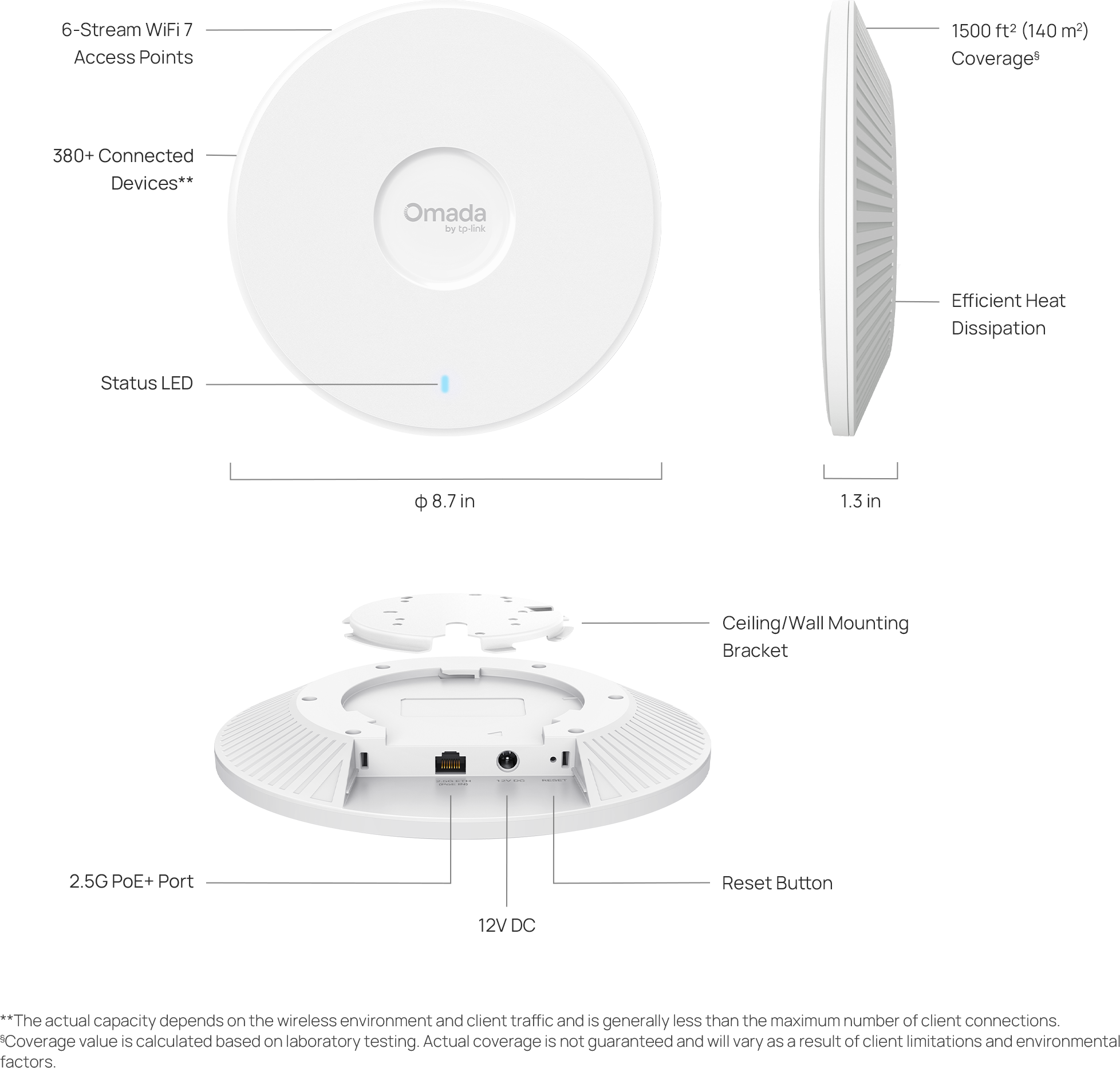
| Ethernet port | 1× 2.5GbE |
| Power | 802.3at PoE+ or 12V/2.5A DC (adapter not included); max consumption 25.4 W PoE, 21.8 W DC |
| Antennas | 2.4 GHz: 2× 4.0 dBi; 5 GHz: 2× 5.0 dBi; 6 GHz: 2× 5.0 dBi; separate Bluetooth 5.2 antenna |
| Coverage and clients | Up to 1,500 ft² (140 m²); 380+ concurrent devices, lab figures |
| Mounting | Ceiling, wall, or junction box, kits included |
| Dimensions | 8.7 × 8.7 × 1.3 in (220 × 220 × 32.5 mm) |
| Management | Omada Cloud-Based, hardware, or software controller; Omada App; SNMP v1/v2c/v3; local and remote syslog; LED on/off control |
| Wireless functions | Mesh, seamless roaming (802.11k/v/r), load balance, band steering, beamforming, airtime fairness, 24 SSIDs (8 per band), wireless and reboot schedules, QoS (WMM), rate limiting, static or dynamic IP |
| Security | WPA/WPA2/WPA3 in Personal and Enterprise, WPA3 Suite B, Enhanced Open, captive portal, access control with 4,000-entry MAC filter, client isolation, VLAN, RADIUS accounting, rogue AP detection |
| Certification | Wi-Fi Alliance Wi-Fi 7 (R1), Wi-Fi 6 (R2), Wi-Fi 6E, WPA3-R3, WPA3-Suite B, Enhanced Open; FCC/CE/NCC/VCCI/JRF/BSMI |
| Operating range | 0 to 40 °C (32 to 104 °F), 10 to 90 percent humidity non-condensing |
| MSRP | $169.99 (TP-Link Omada Wi-Fi 7 lineup comparison page) |
Side by side with the 10G sibling
This is TP-Link’s own comparison table for the two ceiling-mount tier-one models, trimmed down to the rows that change a buying decision:
| EAP772, this post | EAP773 | |
|---|---|---|
| Speed class | BE11000, tri-band, 6-stream | BE11000, tri-band, 6-stream |
| Uplink | 1× 2.5G RJ45 | 1× 10G RJ45 |
| Power | 802.3at PoE+ or 12V DC | 802.3at PoE+ or 12V DC |
| Coverage and clients | 1,500 ft², 380+ | 1,500 ft², 380+ |
| Dedicated RF scanning radio | No | No |
| MSRP | $169.99 | $189.99 |
Read that table carefully, because it is the whole argument. Radio class, coverage, client count and power method are identical between the two. The entire $20 delta is the uplink port speed. TP-Link does not put a dedicated RF scanning radio on either of them at this tier — that feature shows up one level up on the EAP787, which also goes to 8 streams and BE15000.
Where an installer would actually put this
On any access layer that is already 2.5G. If the switch feeding the drop is an SG2210XMP-M2, an SG3218XP-M2, or anything with 2.5G PoE+ access ports, this AP matches the pipe exactly. You are not buying throughput you cannot use, and you keep your 10G ports on the distribution layer where they do real work for uplinks and storage.
Where PoE budgets are tight. Power draw tops out at 25.4 W, which lives inside 802.3at. That matters more than people think on a dense switch with a fixed budget. Spec an eight-port access switch with a modest budget, hang six PoE++ hungry APs off it, and you get the brownout reboot at two in the afternoon on a Monday. Spec APs that stay in PoE+, and the budget stops being a problem.
Office floors, clinics, restaurants, classrooms. 1,500 square feet and 380-plus clients puts it squarely in normal commercial territory. It supports 24 SSIDs, WPA3 Enterprise, RADIUS accounting, captive portal and rogue AP detection, which is everything a managed network actually needs day to day.
Mesh and roaming deployments. Mesh and seamless roaming over 802.11k/v/r both require an Omada controller — cloud-based, hardware, or software. Not a criticism, it is how the platform works, but it is a line item on the quote and the AP cannot roam on its own.
On-site management convenience. The separate Bluetooth 5.2 antenna pairs with the Omada App, which is useful when you are on a ladder and would rather not open a laptop to confirm the AP joined.
Pros and cons
Pros:
- Full BE11000 tri-band Wi-Fi 7 radio at $20 less than the 10G sibling, with identical coverage and client class
- Runs on 802.3at PoE+ at 25.4 W, so it fits switch budgets that cannot carry PoE++ draw
- 2.5G uplink matches 2.5G access layers exactly, which is where most mid-size jobs actually sit
- Junction box mounting kit in the box, and a 32.5 mm thin puck that disappears on a site visit
- 24 SSIDs, WPA3 Enterprise with Suite B, rogue AP detection and SNMPv3 — genuine management, not SMB firmware in a blazer
- Full Wi-Fi Alliance certification for Wi-Fi 7 R1, not a pre-certification claim
Cons:
- The single 2.5G port is the hard ceiling on wired throughput. On a 10G access switch the EAP773 is the better pairing at twenty dollars more
- No dedicated RF scanning radio, which is exactly the feature that separates this tier from the EAP787
- DC adapter not in the box, so budget 12V/2.5A separately if a site cannot run PoE
- Mesh, captive portal, cloud access and seamless roaming all need an Omada controller
- Indoor only, rated to 40 °C. Outdoors go to the outdoor SKUs on the same lineup page
Bottom line
If your access layer speaks 2.5G, specify the EAP772 and bank the difference on every drop in the building. If the switch feeding the AP has a 10G port and you want every megabit the radio can put on air, pay the twenty for the 10G sibling, because the radio is the same and the port is the only thing you are buying.
Both land on the same Omada controller with the same management stack, the same WPA3 toolset and the same roaming behavior, so this is a switching-infrastructure decision wearing an access point’s clothes. Price it off the switch port you are actually wiring to, not off the radio spec sheet.
Questions about a quote or a site survey? Get in touch.
Specification and comparison data sourced from TP-Link’s official Omada product pages, specifically the EAP772 US product and specification page and the Omada Wi-Fi 7 lineup comparison. Product images courtesy of TP-Link.