
Grandstream GDS3720 Series Review: The Door Station That Swallowed the Camera, Intercom, and Access Panel
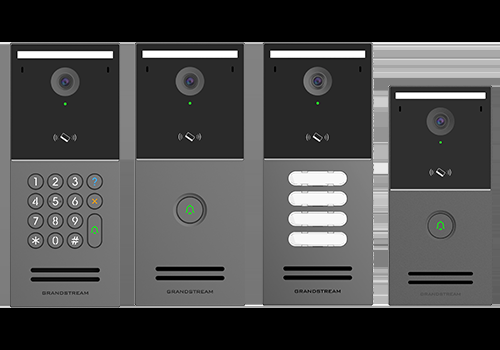
Door hardware is where a VoIP quote usually gets complicated: separate access panel, separate camera, separate relay box, three power supplies, and a Wiegand run nobody terminated right. The Grandstream GDS3720 series collapses all of that into one PoE drop. The lineup is the GDS3725, GDS3726, GDS3726Q, and GDS3727 — a family of smart IP video door stations that double as a 2K surveillance camera and a SIP intercom, with onboard access control that keeps working when the PBX has a bad day. Grandstream’s official spec sheet backs every number below.
Verified specifications (per Grandstream’s official datasheet)
| Feature | GDS3725 (row as listed for the wired family) | GDS3727 |
|---|---|---|
| Camera | 1/3″ 4MP sensor with HDR, F2.2 lens, 127°H x 70°V x 152°D FOV, up to 1920×1080 video and snapshots at 30 fps | Same platform camera |
| WDR / low light | Up to 120 dB WDR, AI ISP, auto-brightness white fill light (6x LED) | Same |
| RFID | 13.56 MHz IC + 125 kHz ID; MIFARE Classic 1K/4K, Ultralight, PLUS, DESFire; up to 5,000 cards/users | Same reader platform |
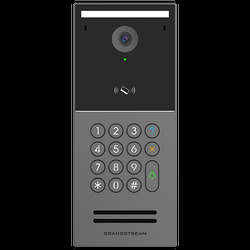
| Keypad | GDS3725: 15-key keypad (12 standard, manager, clear, doorbell); GDS3726Q: 4 quick keys; GDS3727: doorbell key | No keypad — 4 quick keys on 3726Q style; GDS3727 doorbell key only |
| Relays / I/O | GDS3725: 2x SSR relay outputs (lock + alarm), 3 alarm inputs, RS-485, Wiegand 26/34 in/out, 2x GND; GDS3726/3726Q: 1x SSR relay output, 2 alarm channels | Per-row datasheet entries list the wired I/O on the GDS3725 headline column; GDS3727 datasheet column lists Wi-Fi and quick-key layout |
| Wireless | BLE 5.0 | BLE 5.0 + dual-band Wi-Fi 6 (2.4/5 GHz) |
| Network | 1x 10/100 Mbps RJ45 with integrated PoE (802.3af) | Wi-Fi-first design, 12 V DC 12 W power |
| Protection | IP66 weatherproof, IK10 vandal resistance including metal surface, buttons and lens area | IP66, IK07 vandal resistance |
| Audio | Dual built-in microphones, 3 W speaker, AI noise reduction | Same |
| Unlock methods | PIN, IC/ID cards, NFC, Bluetooth, QR code, SIP call, SecureAccess app | Same |
| Protocols | SIP, ONVIF Profile S, RTSP, TR-069, 802.1X, TLS/SRTP/HTTPS, Ed25519/X25519 | Same |
| Analytics | AI motion detection, intrusion/loitering detection, PIR 3–5 m | Same |
| Management | Local web GUI, GDS Manager (client/server), GDMS cloud, SecureAccess app, Home Assistant integration | Same |
| Storage | microSD up to 256 GB (Class 10/V10 min, V30+ recommended) | Same |
| Environment | -30°C to 60°C operating, 10–90% humidity non-condensing, FCC/CE/RCM/IC | Same |
What actually matters on a job
The solid-state relay is the headline for installers. Most door stations use an electromechanical relay; Grandstream put an anti-magnetic SSR on the lock circuit across the whole GDS3720 line. If you have ever had a door controller throw ghost triggers because a big magnetic lock’s coil field washed over the relay board, you already know why this matters. Three alarm inputs and two outputs on the 3725/3726 give you the door sensor, exit button, and a stray zone without an extra I/O module.
Wiegand both directions. The GDS3725/3726/3726Q carry Wiegand 26/34 input and output plus RS-485 — so the door station can front an older panel as a reader, or feed a panel as a reader itself. Check the per-model datasheet column before committing a panel-integration job — the wireless-first 3727 is the outlier with quick keys and Wi-Fi 6. That single spec decides which model goes on which job.
One drop does three devices. PoE (802.3af class, 9–36 V DC input range on the wired models) powers the station while delivering SIP, ONVIF Profile S video to any NVR, and RTSP streams. The onboard AI handles motion, intrusion and loitering with real-time alarms — email, FTP snapshot, app push, GDS Manager, or Home Assistant. Local microSD recording up to 256 GB means credential verification keeps happening even when the network drops.
The management story is genuinely multi-layer. Small job? SecureAccess app on the owner’s phone — users, temporary passwords, live view, logs. Multi-site property portfolio? GDMS cloud, free, batch provisioning over TR-069 with AES-encrypted configs. On-prem server shop? GDS Manager client/server over LAN or WAN. Every door-open is logged: card, PIN, app, QR, or call.
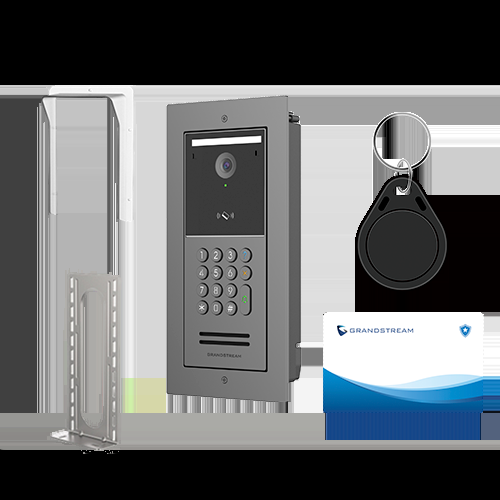
Install notes from the spec sheet worth pre planning: the flush-mount path on the GDS3725/3726/3726Q runs solid wall, drywall or stud, so pull the in-wall box before sheetrock rather than after. Keep the PoE run under the standard 100 m and terminate cleanly — the 10/100 port has no excuses waiting for it. Use a V30-or-better microSD if local recording matters; a cheap card is the first thing to fail on a 24/7 write duty cycle. And if you keep the customer on existing 125 kHz proximity cards, verify the reader family before promising it — the dual-band reader (13.56 MHz and 125 kHz, MIFARE Classic, Ultralight, PLUS and DESFire) means you usually can, which is exactly what you want on a retrofit.
Pros and cons
Pros: anti-magnetic SSR on every model; AI ISP plus 120 dB WDR means faces read at night under a porch light; dual RFID bands (13.56 + 125 kHz) so you can keep existing cards; 5,000 users and 5,000 cards onboard; BLE 5.0 whole line plus Wi-Fi 6 on the 3727; full SIP/ONVIF/RTSP standards support plays with non-Grandstream stacks; IP66 with IK10 through the lens area on the flagship models; the GDS3725/3726 ship with a flush-mount path for solid wall, drywall and stud.
Cons: 10/100 Ethernet only — fine for one door, but you’re not aggregating through it; the GDS3727 is a step down at IK07 and drops to quick keys; the keypad model is the GDS3725, and the datasheet itemizes the fullest relay/Wiegand/RS-485 I/O set against it; no PoE pass-through; and the app/cloud management (SecureAccess/GDMS) means the full experience assumes internet — an air-gapped shop should plan around local web GUI plus GDS Manager instead.
Where I’d spec it
Professional entryway retrofit: GDS3725 with the in-wall box and rain cover, Wiegand output into the existing panel, SIP to the UCM6300 or any SIP platform, ONVIF stream to the NVR. Apartment or condo front door: GDS3726Q, app-based resident access, temporary QR codes for contractors — the 5,000-user database lives onboard so the office doesn’t become the bottleneck. Gate or outbuilding where trenching is stupid: GDS3727 on Wi-Fi 6 with the relay firing the gate strike. Mixed estates: GDMS across all of it with one login per site.
Bottom line
The GDS3720 series is the rare access product where the access panel, camera, intercom, and reader are genuinely one device, one PoE drop, one management system — and the anti-magnetic relay alone saves call-backs on magnetic-lock jobs. Pick the GDS3725 when you need the keypad and Wiegand, the 3726/3726Q for clean minimal entries, and the 3727 where Wi-Fi is the whole point. If you want a door station that behaves like infrastructure instead of a gadget, this is the family to quote. Get in touch through the contact page and we’ll price out your entryway.
Specifications sourced from Grandstream’s official GDS3720 series product page and official datasheet (GDS3725/GDS3726/GDS3726Q/GDS3727, rev V1.0). Product images courtesy of Grandstream Networks.