
Synology RS2423+ Review: The 12-Bay Rack NAS Where Built-In 10GbE Finally Became Standard
The RS2423+ is the box Synology quietly built for people who outgrew the towers but are not ready to pay enterprise array prices for a shelf of spinning rust. Twelve hot-swap bays in 2U, a quad-core Ryzen with ECC memory, and 10GbE soldered to the board — for a small IT shop or an installer wiring up a branch office, this is the value center of the Plus rack line.
What the RS2423+ actually is
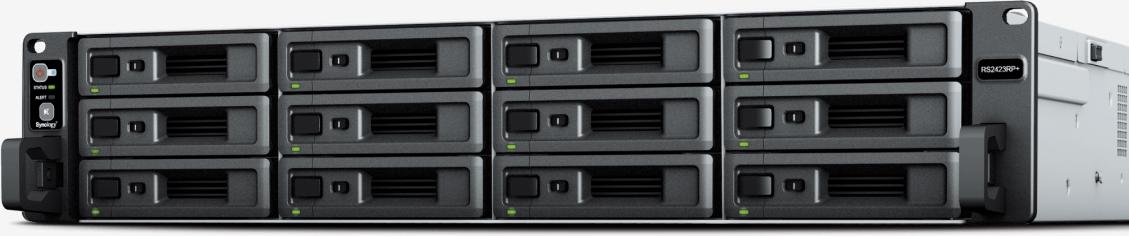
At its heart sits an AMD Ryzen V1780B — four cores, 64-bit, 3.35 GHz base / 3.6 GHz turbo, with a hardware encryption engine — backed by 8 GB of DDR4 ECC UDIMM expandable to 32 GB. ECC on a Plus-series box used to be an XS-series privilege, and its presence here matters the moment the box stops being a file share and starts being a backup target or an iSCSI datastore.
Synology rates it at over 3,500/1,700 MB/s sequential read/write — the sister RS2423RP+II (same platform, redundant power) posts over 155K/79K random read/write IOPS on Synology’s internal charts, roughly 27%/26% faster than the previous RS2421 generation. You will not soak 3.5 GB/s through a single 10GbE port, but you will soak it through bonded 1GbE plus 10GbE with several clients pulling at once, which is exactly the officewide workload it is rated for.
Verified specifications
Everything below is straight from the official Synology RS2423+ datasheet.
| Item | RS2423+ | RS2423RP+II (sister model) |
|---|---|---|
| Form factor | 2U desktop-rackable tower (88 x 482 x 552 mm, 11.5 kg) | 2U rackmount (88 x 482 x 578 mm, 11.9 kg) |
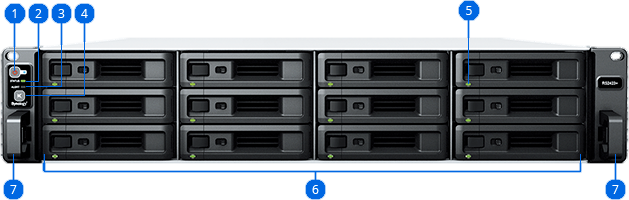
| Drive bays | 12 (3.5″ SATA HDD / 2.5″ SATA SSD), hot-swap | 12, hot-swap |
| CPU | AMD Ryzen V1780B quad-core, 3.35/3.6 GHz, HW encryption engine | Same |
| Memory | 8 GB DDR4 ECC UDIMM, 2 slots, max 32 GB | Same |
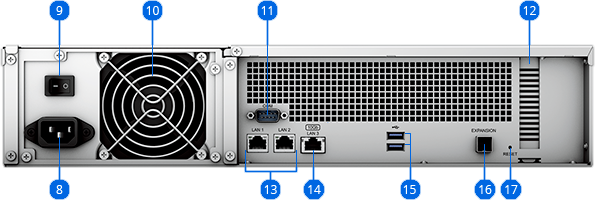
| Networking | 1x 10GbE RJ-45 + 2x 1GbE RJ-45 (link aggregation / failover) | Same |
| PCIe | 1x Gen3 x8 slot (x4 link) — E25G30-F2 25GbE, E10G30 10GbE, E10M20-T1 combo, M2D20 cache cards | Same |
| Expansion | Up to 24 bays / 432 TB raw with one RX1223RP unit (Mini-SAS HD expansion port) | Same |
| Power | Single PSU | Hot-swappable redundant PSUs (550 W rev) |
| RAID | SHR, Basic, JBOD, 0/1/5/6/10; max volume 200 TB (32 GB RAM required above 108 TB) | Same |
| SSD cache | Yes — 2.5″ SATA in bays, or NVMe via M2D20/E10M20-T1 | Same |
| Warranty | 3 years, extendable to 5 (Extended Warranty Plus / EW202) | Same |
Software ceilings that matter on a job sheet: 510 max SMB connections (FSCT), 1,024 local users, 256 shared folders, 64 iSCSI targets / 128 LUNs, 4,096 snapshots per system with 32 replication tasks, RPO down to five minutes, VMM recommended at 8 VMs / 8 Virtual DSM instances (one license included), and Surveillance Station at 75 channels (1080p/3MP at 2,250 total FPS H.264) with 2 licenses in the box and 8,300+ validated camera models.
Pros
- Built-in 10GbE at this price point — bonded gigabit gives you free network failover on top of it.
- ECC memory standard; the one line item that actually protects a backup target from silent corruption.
- License-free data protection: Snapshot Replication, Hyper Backup, Active Backup for Business (Windows, Mac, Linux, VMware, Hyper-V, M365 and Google Workspace) — no per-seat fees.
- One RX1223RP takes you to 24 bays / 432 TB raw over Mini-SAS HD without a second chassis on the network.
- WORM immutable snapshots plus full-volume encryption — the ransomware story installers get asked about weekly.
- Active-Passive Synology High Availability between two identical units (note: active-active lives in the PAS line, don’t let a customer conflate them).
Cons
- Single power supply on this exact model. Redundancy starts at the RS2423RP+II — if the box feeds production VMs, that is where the quote should go.
- Rails (RKS-02) sold separately. Budget them like any real rack install.
- No onboard M.2 slots — NVMe cache means spending the PCIe slot on an adapter card, and then you have no PCIe slot left.
- DDR4 capped at 32 GB total across two slots. Fine for files and backups; check before promising it as a hypervisor.
- 3,500 MB/s needs SSDs or cache — a shelf of spinning disks will not show those numbers.
- RAID F1-style flexibility ends at SHR; big odd-shaped arrays want even bays.
Where I actually put this box
Branch office file + backup consolidation. Twelve bays of mirror-plus-parity SHR, bonded dual gigabit for failover, 10GbE up to the core switch. Active Backup handles the laptops and the local hypervisor, snapshot replication sends critical shares back to HQ nightly with a five-minute RPO option for the folders that matter.
Media and post-production staging. Hybrid Share keeps hot folders cached locally while bulk footage rides in Synology C2 — the bandwidth economics of that setup only work with 10GbE at the desk, which the RS2423+ has on board.
SMB surveillance consolidation. 75 channels under Surveillance Station with ONVIF coverage is enough for a dozen-camera school or dealer lot, and footage lands on local disks — an easy compliance conversation compared to cloud-subscription VMS.
Installer notes: order 32 GB Synology ECC at install time (the datasheet explicitly ties warranty support to Synology memory, and the 200 TB volume ceiling requires it); put both gigabit ports in a bond even if only one is cabled, so failover is free later; and cable the Mini-SAS HD expansion port now even if the RX1223RP comes next fiscal year — blanking plates lie.
The software layer is the reason installers sign on
Hardware quotes sell the box; DSM is what keeps the client on the platform. Snapshot Replication runs scheduled point-in-time snapshots of shared folders and LUNs with an RPO as low as five minutes and recovery measured in seconds — and paired with WORM immutable snapshots, a ransomware encryptor that gets domain admin still cannot rewrite yesterday’s snapshot. Hyper Backup dedupes and encrypts to C2, public cloud, USB, or a second Synology, and Active Backup for Business covers Windows, macOS, and Linux endpoints plus VMware and Hyper-V VMs with no per-agent licensing. That last line is the entire sales conversation against cloud seat fees: one box, no meter running.
On the collaboration side, DSM ships Drive (rated to 930 users and 15 million hosted files on this platform), Office with real-time co-editing and Office-format conversion, Chat, Calendar, and MailPlus with five accounts included. Virtual Machine Manager recommends eight VM instances and includes one Virtual DSM license, and Storage Console for VMware or Windows offloads VAAI and ODX operations — enough to run a small office’s file tier AND its VM tier on one chassis. Surveillance Station tops out at 75 cameras here against 8,300-plus validated camera models with ONVIF support, and Central Management System lets several of these boxes report into one pane of glass across sites.
One more practical note from the rack: the datasheet caps a single volume at 200 TB and requires the full 32 GB of memory above 108 TB, so if the customer wants twelve 20 TB drives in one SHR pool — the datasheet headline ceiling — buy the second DIMM at install time, not the year the pool fills up.
Bottom line
If you need twelve bays, ECC, and built-in 10GbE without climbing into the XS enterprise tax, the RS2423+ is the sane default, and the only reason to pay for the RP+II is the redundant power supply — which for a rack that hosts production workloads, it isn’t really an option anyway. Either way you land on the same platform, the same license-free backup suite, and the same expansion path. For sizing the drive and expansion list against your retention math before you quote it, get in touch.
Specifications sourced from the official Synology RS2423+ datasheet and product page; product imagery courtesy of Synology Inc.